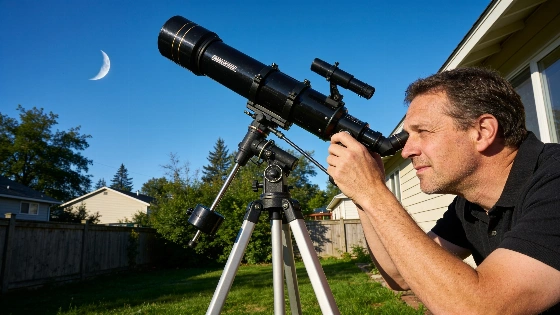
A rare daytime occultation will see the Moon pass in front of Jupiter on September 8, with the best viewing opportunities for North America. Observers will need careful planning and optical aid to catch the event in daylight
Jupiter will disappear behind the Moon in broad daylight on September 8, offering a rare occultation visible to much of North America. This event, challenging even for experienced observers, will require precise timing and optical assistance to witness as the Moon's thin crescent overtakes the solar system's largest planet in the afternoon sky.
Daylight Occultation and Visibility
The occultation will occur during daylight hours, with the Moon's sunlit limb gradually covering Jupiter before the planet reemerges from the Moon's dark edge. The event will be visible across a wide swath of North America, but not everywhere: regions west and south of a line from Bellingham, Washington, to Rockport, Texas, will miss the occultation entirely. For those within the visibility zone, Jupiter will vanish behind the Moon between 2:55 and 3:30 p.m. Eastern Time, 1:45 to 2:20 p.m. Central, and 12:30 to 1:00 p.m. Mountain, depending on location. The planet will reappear roughly 50 minutes later, though exact times vary by several minutes across different cities.
Both the Moon and Jupiter will appear lower in the sky than the Sun and offset to its right, making their detection in daylight especially difficult. The Moon will be a waning crescent, less than 10% illuminated, and Jupiter will be about one-sixtieth the Moon's diameter-barely a pinpoint in the blue sky even through a telescope.
Preparation and Observing Strategy
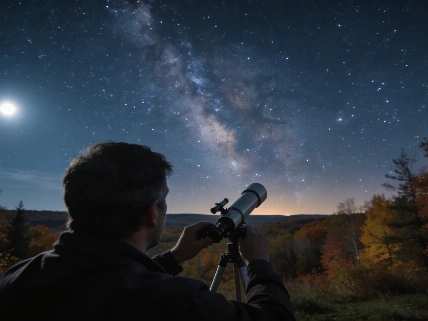
Locating the Moon and Jupiter in daylight is a significant challenge. The most effective approach is to identify the pair before sunrise, when the sky is still dark enough for both to be visible to the naked eye or through binoculars. On September 8, the crescent Moon will rise in the east-northeast before dawn, with Jupiter positioned about 5 degrees below it-roughly half the width of a clenched fist at arm's length. Observers should check for obstructions on the horizon and set up telescopes or binoculars in advance.
As daylight strengthens, tracking the Moon and Jupiter becomes more difficult. Observers should continue to monitor their position, aiming about 30 degrees-four fist-widths-rightward and slightly lower than the Sun. Atmospheric conditions play a critical role: a deep blue, haze-free sky increases the odds of success, while haze or thin cloud can render both objects invisible. Even with a telescope, Jupiter's low surface brightness and small apparent size make it a demanding target.
Scientific and Observational Context
Occultations of bright planets by the Moon are infrequent, especially during daylight. These events provide opportunities to test observational skill and instrument performance under challenging conditions. For astronomers, the occultation also offers a chance to observe Jupiter's cloud belts and atmospheric features as the planet emerges from solar conjunction, having been hidden in the Sun's glare for much of July and August. The event's timing and geometry are determined by the precise orbits of the Moon and Jupiter, and the visibility zone is sharply defined by their apparent paths across the sky.
For those unable to observe this occultation, another close approach between the Moon and Jupiter will occur before sunrise on October 6, when both will be visible in a dark or twilight sky. As reported earlier, planetary conjunctions and occultations offer valuable opportunities for both amateur and professional astronomers to refine their techniques and test the limits of visual and instrumental detection.
Numerical Details and Timing
Jupiter rises shortly before 4:00 a.m. local daylight time on September 8, but does not reach a favorable altitude until just before dawn. The Moon's crescent will be less than 10% illuminated, making it a subtle target even in the best conditions. The occultation's disappearance phase lasts about one minute as the Moon's limb covers Jupiter, with reappearance occurring approximately 50 minutes later. Observers should interpolate between published city times to estimate the event's timing for their specific location. Binoculars or a small telescope are essential for daylight observation, as Jupiter's apparent diameter is only about 1/60 that of the Moon.
Missing the event is likely for many, given the difficulty of daylight planetary observation. However, the next lunar-Jupiter encounter in October will be far easier to observe, with both objects visible against a darker sky and requiring less specialized equipment or preparation.
Occultations occur when one celestial body passes directly in front of another, temporarily blocking it from view. In this case, the Moon's motion across the sky causes it to cover Jupiter as seen from specific locations on Earth. The timing and visibility of an occultation depend on the observer's position, the angular sizes of the objects, and the brightness of the sky. Daylight occultations are especially challenging because the contrast between the objects and the sky is low, requiring careful planning, optical aid, and favorable atmospheric conditions to detect the event at all.