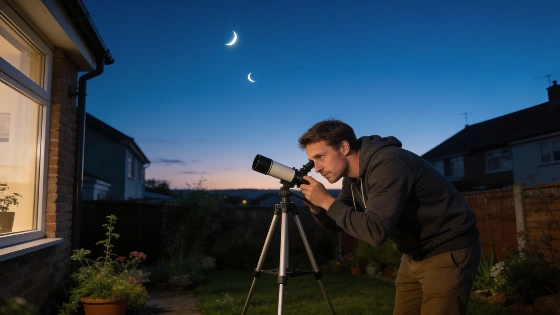
Venus is now visible as a striking crescent through small telescopes as it draws closer to Earth and prepares to pass between our planet and the Sun, offering a rare chance to observe its changing phases and orbital motion
Venus, long mistaken for a static beacon in the evening sky, is now undergoing a transformation that exposes the true mechanics of planetary motion. As the planet closes in on inferior conjunction-when it passes between Earth and the Sun-its brilliant point of light is replaced by a striking crescent, visible only through telescopes or binoculars. This fleeting phase, often overlooked by casual observers, is the key to understanding Venus's orbit and its place in the solar system.
Changing Illumination and Apparent Size
Throughout September, Venus's illuminated fraction is shrinking rapidly. The planet's disk, which appeared 36% lit at the start of the month, will diminish to just 32% as it approaches its closest alignment with Earth. At the same time, Venus's apparent diameter is increasing, a direct result of its decreasing distance from our planet. By October 24, Venus will reach inferior conjunction, passing just 0.27 astronomical units (about 40 million kilometers) from Earth-its closest approach during this cycle.
This geometric dance is not just a curiosity. The changing phase and size of Venus are direct consequences of its orbit inside Earth's, a fact that eluded astronomers until the invention of the telescope. The planet's greatest brilliancy in the evening sky will occur on September 18, when it shines at magnitude -4.8 while only 26% illuminated. After this peak, Venus will become an even thinner crescent, eventually lost in the Sun's glare.
Observational Techniques and Safety
Venus's crescent phase is invisible to the naked eye, but even modest optical equipment can reveal it. A small telescope or a pair of 10x50 binoculars is sufficient to distinguish the planet's changing shape. Observers must exercise caution: never attempt to locate Venus with optical instruments before sunset, as accidental exposure to the Sun can cause permanent eye damage. The safest approach is to wait until the Sun has fully set before scanning the western sky.
Atmospheric turbulence near the horizon can cause Venus to shimmer or distort, but the crescent shape remains discernible. The planet's path through the constellation Virgo this month will culminate in a close conjunction with the waxing crescent Moon on September 14, when both bodies will appear as crescents in the same patch of twilight sky-a rare and visually compelling pairing.
Historical and Scientific Significance
The phases of Venus played a pivotal role in the history of astronomy. When Galileo Galilei observed Venus through his telescope in the early 17th century, he documented a full sequence of phases, from gibbous to crescent. This observation directly contradicted the Ptolemaic geocentric model, which could not account for the complete range of phases, and provided strong evidence for the heliocentric system in which planets orbit the Sun.
Today, the same phenomenon remains a powerful demonstration of planetary motion. Unlike Mars, Jupiter, or Saturn, which reveal surface features or rings, Venus's thick cloud cover reflects sunlight so efficiently that no surface detail is visible. Its phases, however, are a geometric signature of its orbit, offering a rare opportunity for direct visual confirmation of solar system dynamics.
Venus in the Broader Night Sky
Venus is not the only planet drawing attention this month. As the Moon moves past last quarter, the evening sky becomes darker, revealing the Milky Way and deep-sky objects before autumn constellations dominate. Saturn is now brightening in the eastern sky after dark, making it an ideal target for small telescopes. Meanwhile, Neptune is nearing opposition within the constellation Pisces, reaching its brightest point of the year-though it remains a challenge for all but the most determined observers.
For those tracking celestial events, the interplay of Venus and the Moon on September 14 stands out as a highlight. This conjunction, with both bodies appearing as crescents, offers a vivid reminder that planetary and lunar phases are governed by the same principles of reflected sunlight and orbital geometry. The current visibility of Venus's crescent phase is a rare alignment, not to be repeated for several years.
Venus's transformation from a dazzling evening star to a delicate crescent is a lesson in the power of observation over assumption. While the planet's brilliance often masks its true nature, the current phase sequence exposes the underlying mechanics of the solar system in a way that is both accessible and scientifically profound. As with the reported earlier anticipation for the 2026 total solar eclipse, these moments of alignment are not just visual spectacles-they are opportunities to witness the evidence that shaped our understanding of planetary motion. The enduring value of such observations lies in their ability to connect abstract models with direct experience, grounding astronomical theory in the shifting light of a neighboring world.
Understanding the phases of Venus requires a grasp of how planetary orbits and illumination interact. As Venus moves along its orbit inside Earth's, the angle between the Sun, Venus, and Earth changes, altering the portion of the planet's day side visible from our perspective. When Venus is on the far side of the Sun, it appears nearly fully illuminated but small; as it approaches inferior conjunction, the illuminated fraction shrinks to a thin crescent while the apparent size grows. This interplay of geometry and light is the same principle that produces lunar phases, but on a planetary scale, offering a direct, observable link between orbital mechanics and the changing face of the night sky.