A steel centaur-like robot called Threehalves has drawn attention for its four-legged design and modular tool system, aiming to perform dangerous tasks in unstable or hazardous settings where conventional robots struggle
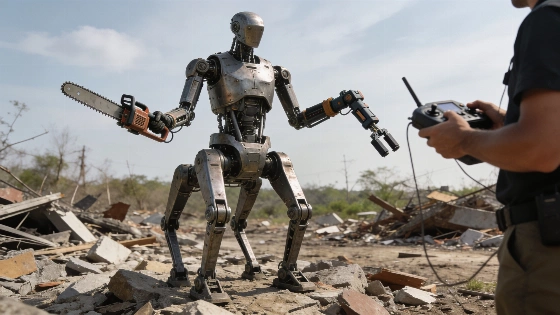
A prototype robot named Threehalves has attracted widespread attention after images of its distinctive four-legged, horned form circulated online. Developed by engineer Beau G. and a small team in Northern California, the nearly two-meter-tall machine is designed to perform physically dangerous tasks in environments that pose significant risks to human workers. The robot's steel frame combines a humanoid upper body with a quadrupedal base, aiming to improve stability and mobility on uneven or unstable terrain.
Remote Control and Stability
Threehalves is not a fully autonomous system. Instead, it is teleoperated: a human operator controls the robot's movements and actions remotely, using a standard game controller or joystick. This approach allows the robot to be deployed in environments where direct human presence would be unsafe, such as disaster zones, unstable rubble, or areas with hazardous materials. The robot's upper body is designed for intuitive control, while its four-legged base lowers its center of gravity, reducing the risk of tipping or collapse compared to bipedal robots. Each joint incorporates passive friction, enabling the robot to hold positions without consuming power when stationary.
Modular Tools and Fail-Safe Systems
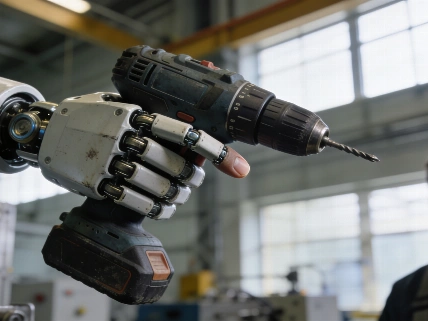
The robot's modular arm mounts can be equipped with a range of tools, including chainsaws, drills, and industrial screwdrivers. Rather than using dexterous hands, Threehalves employs quick-connect interfaces that supply electrical power and pressurized air directly to attached equipment. This design allows for rapid tool changes in the field, with damaged components replaceable in minutes without specialized facilities. The pneumatic actuation system includes fail-safe mechanisms: if air pressure is lost, automatic brakes and pin locks engage to prevent uncontrolled movement or collapse. Exposed air reservoirs on the chest serve as an emergency shutdown point, allowing anyone nearby to disable the robot without remote access or codes.
According to the developers, Threehalves is intended for use in environments where conventional robots—especially bipedal humanoids—are prone to failure due to balance issues or power loss. The quadrupedal configuration enables the robot to traverse soft ash, steep slopes, and debris-strewn surfaces that would challenge wheeled or two-legged machines. Cameras integrated into the horn assembly provide multiple viewpoints, including feeds from the arms, tools, and legs, and serve as backup vision if joint sensors fail. The system's modularity is intended to support rapid field repairs and adaptation to different tasks.
An Early-Stage Prototype With Unproven Performance
Despite the attention, Threehalves remains an early-stage prototype. The developers have not announced pricing, commercial availability, or whether the robot will meet regulatory requirements for deployment in emergency services or industrial settings. No independent testing or peer-reviewed evaluation has been published, and the system's reliability, safety, and performance in real-world deployments remain unverified.
The project's approach to teleoperation and modularity reflects broader trends in robotics, where researchers are exploring new forms of mobility and control to address the limitations of traditional humanoid and wheeled robots. For comparison, recent advances in full-body humanoid control, such as those reported in Google DeepMind's Gemini Robotics 2 demonstration, have focused on improving adaptability and coordination across different robot platforms, but often face challenges in stability and terrain handling.
Threehalves' design highlights ongoing trade-offs in robotics between autonomy, human supervision, and physical robustness. While the system's teleoperated nature allows for flexible deployment in hazardous environments, it also depends on reliable communication links and skilled human operators. The lack of regulatory certification and independent evaluation means that the robot's suitability for emergency response or industrial use remains uncertain. As with many experimental robots, the transition from laboratory demonstration to field deployment will require further testing, safety validation, and adaptation to regulatory standards.
How Teleoperation Works
Teleoperation is a method of robot control in which a human operator directs the robot's actions from a distance, typically using a physical controller or interface. This approach is common in hazardous environments where direct human presence is unsafe or impractical. Teleoperated robots rely on real-time communication links and sensor feedback, such as video feeds and force data, to provide situational awareness to the operator.
While teleoperation can extend human reach into dangerous settings, it introduces challenges related to latency, situational awareness, and operator workload. The effectiveness of teleoperated systems depends on the quality of the control interface, the reliability of communication, and the robot's ability to provide meaningful feedback about its environment and status.