BYD has begun introducing its humanoid robot Xiao Di in select showroom experience centers across China, aiming to enhance customer interaction as domestic car sales decline and regulatory scrutiny of advanced robotics intensifies
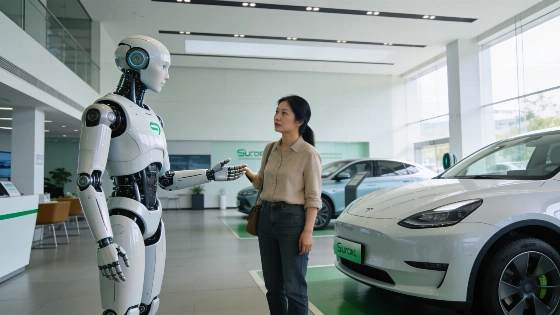
Chinese electric vehicle manufacturer BYD has started deploying its humanoid robot, Xiao Di, in several of its Di Space showroom experience centers in China. The move comes as the company seeks to address falling domestic car sales and to test the viability of humanoid robots in customer-facing retail environments. The initial rollout includes locations in Zhengzhou, Shenzhen, and Shanghai, with plans to expand to additional stores if the pilot proves effective.
Xiao Di is a 1.61-meter-tall, 58-kilogram humanoid robot designed for direct interaction with showroom visitors. According to company specifications, the robot features 31 degrees of freedom, including seven in each hand, enabling a range of gestures and basic manipulation tasks. Xiao Di is equipped with facial recognition, gesture recognition, and lip-reading capabilities, and can communicate in six Chinese dialects as well as six foreign languages. Its primary functions include greeting customers, providing information about vehicle models, answering questions, and demonstrating selected features. BYD has indicated that two or three robots may be deployed per store, with the aim of supporting staff rather than replacing them.
The deployment of Xiao Di is occurring against a backdrop of tightening regulatory scrutiny of advanced robotics. On July 28, the US Federal Communications Commission (FCC) added foreign-produced advanced robotic devices, including humanoid and quadruped robots, to its Covered List, restricting new imports that require FCC authorization. The FCC cited national security and critical infrastructure risks associated with network-connected robots equipped with cameras and sensors. While previously authorized devices can continue to be sold and used in the US, the new restrictions highlight growing policy divergence between the US and China on robotics and AI technologies. Chinese authorities have criticized the US decision, characterizing it as an unjustified trade barrier.
BYD's interest in humanoid robotics is partly driven by a challenging domestic market. According to figures reported by Startup Fortune, BYD's domestic car sales have declined for four consecutive months, with June 2026 domestic sales down 22 percent year over year. In contrast, overseas sales rose by over 70 percent in the first half of the year. The company sold 1,808,511 new energy vehicles globally in the first half of 2026, a decrease of 15.72 percent compared to the previous year. The introduction of Xiao Di is positioned as both a technological experiment and a potential differentiator for BYD's extensive retail network.
Other Chinese electric vehicle manufacturers are also exploring humanoid robotics for retail applications. Xpeng, for example, has announced plans to scale production of its Iron humanoid robot to over 1,000 units per month by the end of 2026, with deployment as showroom sales assistants scheduled for early 2027. These initiatives reflect a broader trend among Chinese automakers to integrate advanced robotics into customer service roles, though most deployments remain at the pilot or demonstration stage.
At present, Xiao Di's capabilities are limited to scripted interactions and basic demonstrations. There is no evidence that the robot operates autonomously beyond predefined tasks, and human staff remain responsible for sales, safety, and customer support. The company has not disclosed independent evaluations of Xiao Di's performance, reliability, or safety in live retail environments. It is also unclear how the robot handles ambiguous or unexpected customer behavior, or how privacy and data protection are managed for facial and speech recognition features. The deployment is best understood as a controlled pilot rather than a fully commercialized product rollout.
According to company-reported specifications, Xiao Di stands 1.61 meters tall and weighs 58 kilograms, with 31 degrees of freedom and seven in each hand. The robot is designed to support six Chinese dialects and six foreign languages, and is equipped with facial and gesture recognition as well as lip-reading. BYD has indicated that two or three robots may be deployed per store, but has not provided data on operational uptime, failure rates, or customer satisfaction. No independent technical audits or regulatory certifications have been reported for the system as of July 2026.
Humanoid robots such as Xiao Di are often presented as a means to enhance customer engagement and differentiate retail experiences. However, the technical and social challenges of deploying such systems at scale remain significant. Key issues include the reliability of speech and gesture recognition in noisy or crowded environments, the risk of automation bias if customers overestimate the robot's capabilities, and the need for robust privacy safeguards when collecting and processing biometric data. The current deployment provides an opportunity to observe how these challenges are addressed in practice, but independent evaluation will be necessary to assess the broader impact and safety of humanoid robots in public-facing roles.
Understanding the distinction between automation and autonomy is essential when evaluating humanoid robots like Xiao Di. While automation refers to the execution of predefined tasks without continuous human input, autonomy implies the ability to make independent decisions and adapt to new situations. Most current retail robots, including Xiao Di, operate within tightly scripted boundaries and require human oversight for safety, troubleshooting, and customer service. The transition from automated demonstration to reliable autonomous operation in complex, real-world environments remains a major technical and regulatory challenge for the field.