ANYbotics says its ANYmal robots can authenticate at restricted doors and pass through existing industrial sites using dormakaba automation and LEGIC credentials, while human oversight and layered security remain part of the operating model.
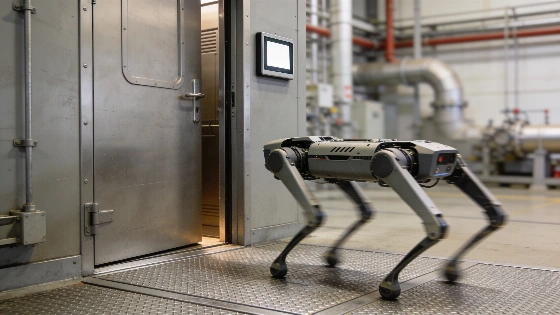
A locked door can stop an inspection robot more effectively than a difficult route. ANYbotics says its four-legged ANYmal machines can now authenticate at restricted entrances and pass through existing industrial facilities through a joint system developed with dormakaba and LEGIC Identsystems.
The claim matters because industrial inspection is rarely confined to one open room. Routes may cross buildings and controlled zones in energy, mining, chemical and metals facilities. A robot that can navigate but cannot obtain authorized access still needs a person to intervene.
LEGIC supplies the digital credential that gives ANYmal an electronic identity. When the robot reaches a protected doorway, it requests entry through dormakaba's exos access-management system. The system checks the permissions assigned to the machine before unlocking the door, allowing operators to specify where ANYmal may go, when it may enter and which inspection work it is authorized to perform.
This is automated access control rather than an open-ended claim of independent judgment. The robot is being connected to the same authorization structure used to manage restricted areas for people and equipment. The reported capability is therefore the execution of an approved access policy, not evidence that ANYmal can decide for itself which industrial zones it should enter.
For unlocked doors, the arrangement uses radar to detect the approaching robot. A retrofitted dormakaba ED 100 or ED 250 swing-door operator then opens the door, lets ANYmal pass and closes it again. Both models are existing operators for swing doors, so the proposed arrangement is intended to reduce the need for a dedicated robotic entrance. The companies describe compatibility with indoor and outdoor installations and fire-rated doors, subject to the requirements of the specific facility.
This architecture illustrates a basic principle of dependable robotics: sensing, authorization and actuation should be treated as separate functions. Radar can detect proximity, but it cannot determine whether entry is permitted. A credential can identify the robot, but it cannot guarantee that the doorway is physically clear. The access platform can enforce a policy, while the door operator supplies mechanical motion. Separating those responsibilities makes failures easier to diagnose and audit, a systems-engineering approach familiar from complex programs at NASA and CERN.
The available evidence is a joint pilot described by the companies rather than an independently reported performance study. Separate industry reports place a demonstration or test at the GE Vernova Whitegate power plant in Ireland, providing a practical energy-sector context. However, no trial count, success rate, failure rate, confidence interval or comparison with alternative access systems is provided in the published material.
The measurable technical detail is limited but concrete: three companies divide the system into three functions. ANYbotics provides the mobile robot, LEGIC provides the secure credential technology, and dormakaba provides access management and door automation. The cited door hardware includes the ED 100 and ED 250 operators. The reports do not state how often the complete system authenticates successfully, how many attempts were made or how many human interventions were required.
That missing information is important because a useful pilot metric would need to distinguish different failure modes. A rejected credential, a network timeout, a robot arriving at the wrong angle, a blocked doorway and a mechanical fault are operationally different events. A rigorous evaluation would also report the number of sites, door types, access transitions and repeated cycles, together with conditions such as communications loss and emergency operation. Those details are not currently disclosed.
Research on legged robots has shown that dynamic locomotion can be evaluated experimentally rather than described only through demonstrations; a peer-reviewed Science Robotics study is one example of that standard. The same distinction applies here. A successful demonstration can establish that the components work together at least once, while a statistically characterized deployment would establish reliability across repeated trials and varied industrial conditions. The available reports support the first conclusion, not the second.
ANYmal can also use tele-assist when it cannot resolve a situation autonomously. A remote operator may intervene, change the mission or send the robot back to its charging dock. That makes the deployment a supervised autonomous inspection system rather than a machine guaranteed to complete every route without human support. In this respect, the operating model resembles other high-consequence automation systems, where autonomy is bounded by escalation paths rather than treated as an all-or-nothing property.
Allowing a machine through a restricted door creates a second problem after authentication: a person might follow behind it. ANYbotics says the integration does not disable existing anti-tailgating protections. Mantraps, interlocks, cameras and security staff can continue to operate as before.
That compatibility is more significant than the novelty of giving a robot a credential. Industrial security depends on authorization, physical design and auditability working together. A digital identity can constrain where the robot is permitted to travel, but it does not by itself prevent misuse, detect every human following through a doorway or resolve a mechanical failure. The same layered principle appears in cybersecurity and laboratory infrastructure at institutions such as MIT, where identity, policy and physical or network controls are not interchangeable.
The arrangement is designed to avoid major structural changes and to keep doors from being left open for machines. It therefore addresses a specific deployment bottleneck: extending an inspection route across existing infrastructure without creating a separate robotic entrance system. It does not establish that autonomous inspection is reliable across every facility or that human supervision is no longer needed.
Industry reports indicate that the deployment model is expected to become available for existing ANYbotics installations and new ANYmal platforms later in 2026. That statement describes planned commercial availability, not evidence that every compatible door or access-control configuration has already been validated. Facility operators would still need to assess local fire-safety rules, emergency egress, credential governance and cybersecurity procedures.
The partnership shows a sensible engineering approach to a mundane but consequential obstacle. Sensors handle approach detection, door operators provide physical movement and an access platform checks permissions. Those components can make a robot more useful without weakening the facility's existing authorization model. As in the evidence culture associated with Nature and other major scientific journals, the key question is not whether a system can be demonstrated, but how broadly and reproducibly its performance has been measured.
The evidence remains a company-described pilot, not a published independent evaluation. The reports do not describe performance during network loss, credential failure, blocked doors, emergency conditions or repeated daily operation. They also do not report a laboratory affiliation, lead researcher, prespecified study protocol or peer-reviewed findings. These omissions do not invalidate the integration, but they limit what can responsibly be inferred from it.
That boundary should shape how the result is understood. ANYmal has gained a controlled way to request and receive access within an industrial security system, while remote assistance remains part of the operating model. The development is valuable because it closes a real physical gap in autonomous inspection, but its strongest demonstrated claim is practical integration rather than proven machine independence.