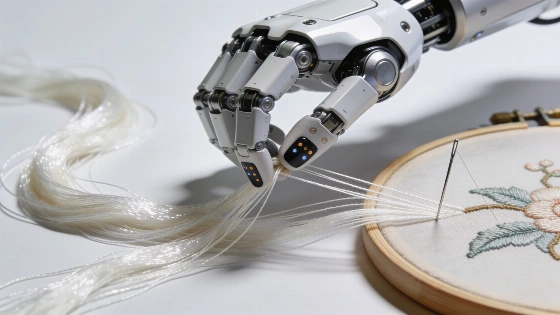
AGILINK's robot hand separated silk into 16 strands, threaded a needle and made initial Suzhou embroidery stitches in a company demonstration focused on tactile control rather than simple gripping.
A robot hand has taken on one of the least forgiving tasks in textile work: separating silk into 16 fine strands before threading a needle and making embroidery stitches. AGILINK's OmniHand 3 Ultra performed the sequence in a demonstration of techniques used in traditional Suzhou embroidery, a craft with a history of more than 2,500 years.
The result is not evidence that the hand can independently reproduce a master embroiderer's work. It is a tightly defined company demonstration that shows how difficult manipulation becomes when the material has no fixed shape and every contact changes its position. The technique was taught by embroidery master Fu Xianghong, linking a modern robotic control problem with a traditional craft.
AGILINK is a spin-off of Chinese robotics company AgiBot. For the demonstration the robot was trained to split silk thread, thread a needle, stretch fabric across an embroidery frame, twist thread and make initial stitches. Fu Xianghong taught the system how to handle the material, including the crucial separation of one main strand into 16 finer strands.
That operation required more than closing a gripper around an object. One finger separated the silk while the other fingers maintained tension. During twisting the fingertips had to remain in contact with the thread while allowing it to rotate. Threading the needle and placing stitches then required coordinated control of position, force and finger movement.
The final sequence also exposed a limitation that matters well beyond embroidery. After the robot twisted and picked up the thread, the thread landed in a different position each time. The hand therefore had to adjust its movement instead of replaying one fixed trajectory. AGILINK says the training combined teleoperation data with reinforcement learning, but the available reports do not provide trial counts, success rates, failed attempts or the amount of human intervention during the final demonstration.
AGILINK describes silk as a material whose shape is determined by the force applied to it. That makes tactile feedback central: vision alone cannot reliably specify how a thin flexible strand is bending, slipping or rotating at the fingertips. The company says fingertip sensors measure three-dimensional force and contact-surface deformation, detecting changes as small as 0.08 millimeters. The tactile system also covers the finger pads and palm, rather than relying only on the tips.
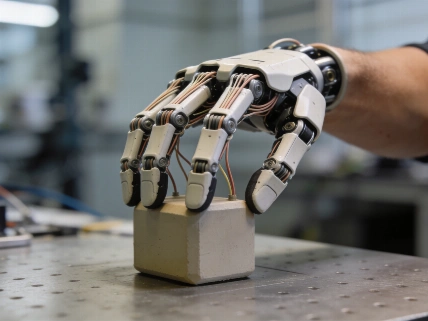
The OmniHand 3 Ultra is about the size of a human hand and weighs approximately 630 grams. Its direct-drive architecture connects motors directly to joints without intermediate transmission mechanisms. The reported design has 21 active degrees of freedom, a stable load capacity of 3 kilograms and a short-duration lifting capacity of up to 8 kilograms. AGILINK also reports an open-close cycle of about 0.3 seconds and positional repeatability of approximately 0.2 millimeters. A palm contact sensor contains about 300 sensing points.
Those specifications describe the platform's reported capabilities rather than embroidery performance. They help explain why the hand can make continuous adjustments, but they do not establish how reliably it can handle different silk qualities, fabric tensions, lighting conditions or unfamiliar embroidery patterns. The demonstration also provides no independent measurement of accuracy or repeatability.
There is an additional identification caveat. AGILINK has not publicly specified the exact model of the hand shown in the video. Independent coverage described the device as visually similar to the OmniHand 3 Ultra-M, so attributing every demonstrated capability specifically to the Ultra version should be treated with caution.
The distinction between a trained manipulation routine and an autonomous craft worker is important here. AGILINK showed a physical hand performing a sequence after training that included teleoperation data and reinforcement learning. That is evidence of learned control for a specific task; it is not evidence that the system can choose designs, diagnose mistakes or work without human preparation and supervision.
The same engineering problem appears in industrial manipulation, where objects deform, slide or arrive in slightly different positions. Boston Dynamics has pursued a different design with the latest Atlas hand, which uses four digits for industrial tasks such as handling drills and welding tools. Readers looking for that contrasting approach can find an earlier Atlas analysis. LinkerBot's Linker Hand L30 Pro instead uses five tendon-driven fingers and emphasizes speed and repeatable movement.
AGILINK's approach places the emphasis on direct actuation, fingertip sensing and software that can respond to changing contact conditions. That is a meaningful direction for robots handling cable, cloth, wire or other compliant materials. It also makes evaluation harder: a short video can show a successful interaction while leaving the distribution of failures, recovery behavior and human resets unknown. The broader robotics literature, including work discussed through Nature robotics research, treats these questions as problems of sensing, control and generalization rather than grip strength alone.
As in research programs at MIT and NASA, the distinction between a laboratory demonstration and a validated operational system depends on how performance is measured across conditions. In this case, the public material documents a demonstration but does not describe a controlled benchmark, sample size, confidence interval or peer-reviewed evaluation.
The strongest claim supported by the evidence is narrow but useful. The demonstrated hand can perform several delicate operations with silk thread, including strand separation, needle threading, fabric handling, twisting and initial stitching, while coordinating multiple fingers and responding to changes in thread position.
It does not show a complete Suzhou embroidery workflow, independent artistic judgment or production readiness. No benchmark, comparative success rate or independent verification is reported. The latest available coverage describes the event as a demonstration of capability; it does not provide evidence of certification for industrial use.
Robotic dexterity is often described through maximum grip force or joint speed, but soft materials expose a different requirement: the machine must estimate contact continuously and change its action before a slip becomes a failure. AGILINK's silk demonstration is valuable because it makes that requirement visible. Its limits are equally clear. Until the company reports repeated trials, failures, intervention rates and performance across varied materials, the OmniHand 3 Ultra remains a promising dexterous prototype demonstrated on a carefully selected task rather than a proven general-purpose manipulator.