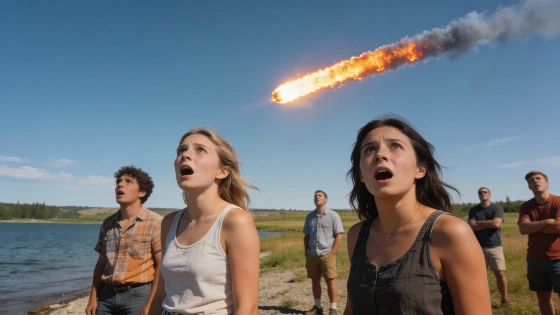
On August 10, 1972, a large meteoroid entered Earth's atmosphere over Utah and exited over Alberta, Canada, producing a rare daylight fireball visible across North America and offering a unique opportunity to study atmospheric entry dynamics
On August 10, 1972, a rare astronomical event unfolded in broad daylight as a large meteoroid entered Earth's atmosphere above Utah, traversed the sky at high speed, and exited back into space over Alberta, Canada. Unlike most meteors, which burn up completely or impact the ground, this object followed a shallow trajectory, allowing it to graze the upper atmosphere and remain largely intact. The event, now known as the "Great Daylight Fireball," was witnessed by observers across the United States and Canada, and remains one of the best-documented daylight fireballs in modern history.
Trajectory and Physical Characteristics
Analysis of the fireball's path indicated that the object entered the atmosphere at a very shallow angle, spending approximately 100 seconds within the upper atmospheric layers. Estimates based on its brightness and observed motion suggest a diameter between 3 and 14 meters, with the range depending on whether the body was composed primarily of ice, as in a comet, or denser rock, as in an asteroid. The fireball's visible track began over Utah and extended northward, with the object exiting the atmosphere over Alberta. No fragments were recovered, supporting the conclusion that the meteoroid did not reach the ground.
Daylight fireballs are exceptionally rare because most meteoroids are too small to produce visible light against the brightness of the daytime sky. The 1972 event was notable for its intensity, with the fireball outshining the Sun for a brief period and leaving a persistent trail visible to thousands of witnesses. The event's duration and trajectory allowed for detailed analysis using both eyewitness accounts and photographic records.
Scientific Significance
The 1972 daylight fireball provided a valuable case study for understanding the dynamics of atmospheric entry at shallow angles. Unlike typical meteors, which plunge steeply and disintegrate rapidly, Earth-grazing fireballs lose only a fraction of their mass and can escape back into space. The observed trajectory and energy dissipation offered insights into the physical processes governing ablation, fragmentation, and the interaction between meteoroids and the upper atmosphere. These findings have informed models of planetary defense and the assessment of impact risk from near-Earth objects.
Events of this scale are infrequent, but their study is essential for refining predictions about the behavior of larger objects that could pose a threat to populated areas. The 1972 fireball's well-documented passage has served as a benchmark for subsequent research on atmospheric entry, complementing more recent observations of close asteroid flybys, such as the anticipated 2029 approach of Apophis, which is expected to be visible to much of Earth's population. For context, researchers have mapped the 2029 flyby of Apophis, predicting that up to 90% of Earth's population could see the object with the naked eye as it passes closer than many satellites, offering a rare opportunity for direct observation (see this analysis of Apophis's upcoming close approach).
Observational Challenges and Modern Context
Most meteors are observed at night, when even small particles produce visible streaks against a dark sky. Daytime fireballs, by contrast, require much larger objects and are rarely recorded in detail. In 1972, the lack of widespread video technology limited the available documentation to photographs and eyewitness reports, though at least one video recording is known to exist. Today, a similar event would likely be captured from multiple angles by smartphones and security cameras, providing a far richer dataset for analysis.
The 1972 fireball also highlighted the importance of coordinated observation networks and rapid data collection. Modern meteor detection systems, including all-sky cameras and satellite sensors, have improved the ability to track and characterize such events in real time. These advances have increased the scientific value of rare atmospheric entries and enhanced planetary defense capabilities.
Understanding the distinction between typical meteors and daylight fireballs is crucial for interpreting observational data. Most meteors are caused by small particles that burn up entirely in the atmosphere, producing brief flashes of light. Daylight fireballs, however, result from much larger objects that can survive atmospheric passage and, in rare cases, exit back into space. The 1972 event remains a key example of this phenomenon, illustrating the range of outcomes possible when near-Earth objects encounter our planet's atmosphere.