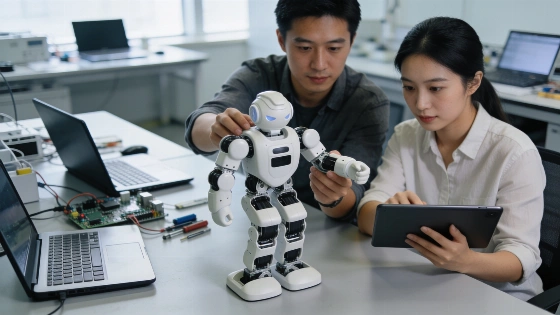
Zeroth has launched Bridge, a desktop-sized humanoid robot built for AI research, along with OpenBridge, an open-source platform for sharing robot skills and development tools. The system is aimed at researchers and hardware builders interested in real-world embodied AI.
Zeroth is now offering Bridge, a compact humanoid robot, to developers worldwide. Alongside the hardware, the company has opened its software ecosystem to outside contributors through the OpenBridge platform. The goal is to make embodied AI research more accessible by providing both a physical robot and a shared repository for motion skills, code, and development tools. This move follows a broader push in robotics to lower entry barriers for researchers, similar to efforts at MIT and Stanford.
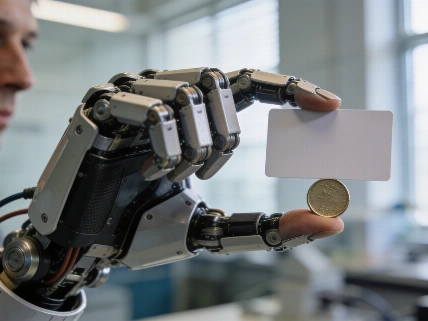
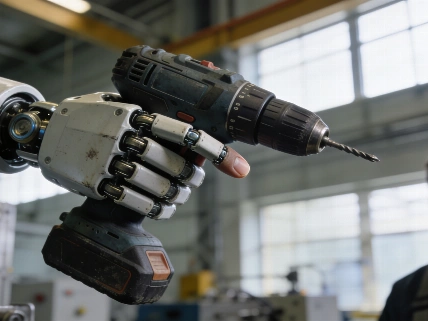
Bridge is designed for accessibility and modularity. At 88 centimeters tall and weighing 13 kilograms, it fits on a desk and can be handled by one person, making it practical for academic labs and independent developers. The robot has arms between 30 and 40 centimeters long, each ending in a two-finger gripper, and uses proprietary high-torque actuators. Zeroth says Bridge can walk on two legs, avoid obstacles, and perform a range of human-like movements, including dynamic walking and full-body teleoperation. Developers get access to software development kits, open motion-control APIs, and tools for motion capture and virtual reality integration, so they can deploy custom algorithms and adapt the robot for specific tasks. These features are similar to modular robotics toolkits described in recent Nature articles on embodied AI.
Bridge differs from conventional robots that run on fixed routines. Its AI-native architecture is meant to support adaptable, data-driven behaviors. The OpenBridge ecosystem includes a public Skill Hub, unified development tools, and shared training resources. Developers can contribute new skills, reuse existing ones, and collaborate on projects without starting from scratch. This approach is in line with recent efforts to make physical skill libraries more reusable, as seen in other modular platforms. Zeroth describes its vision for OpenBridge as creating an "Android for humanoid robots," where capabilities can be shared and reused across the ecosystem.
The Bridge Builder Program will select 500 developers for a co-creation challenge. Of these, 200 will get free access to Bridge hardware and join OpenBridge development, while the other 300 will have priority purchase access and SDK privileges. Zeroth sees this as a way to speed up embodied AI research by distributing both the robot and the development environment to a global community. The Bridge Geek Edition is now available for booking, with international shipping planned. The first batch of Geek Edition units has already shipped, and international coverage describes the launch as completed.
Bridge's technical specs are modest compared to industrial robots but are aimed at research and prototyping. Its size and weight make it suitable for desktop use, and its actuators are designed for high torque relative to its scale. The robot supports bipedal walking and a library of human-like motions, but Zeroth has not published independent benchmark results or detailed failure rates. The open interfaces allow integration with external sensors and software, but real-world robustness and safety have not been tested outside company demos. Independent validation remains important, as is standard in peer-reviewed robotics research at places like CERN and NASA.
By combining a physical robot with open-source software, Zeroth is betting that embodied AI development will move from isolated, hardware-specific projects to more collaborative, software-driven platforms. Still, the lack of independent evaluation, limited safety testing disclosure, and no peer-reviewed results mean Bridge's reliability and adaptability are not yet proven. Distributing hardware to selected developers may help reveal operational limits and speed up the discovery of failure modes, but it also shifts responsibility for safety and robustness to the wider community. For now, Bridge gives researchers a tangible platform for embodied AI experiments, but its long-term impact will depend on transparent reporting, reproducible results, and whether developers share both successes and failures, as emphasized in journals like Science and PNAS.
Embodied AI refers to artificial intelligence systems that interact with the physical world through sensors and actuators, rather than running only in software or simulation. Unlike traditional automation, embodied AI must deal with real-world uncertainty, sensor noise, and mechanical variability. Open-source platforms like OpenBridge aim to make it easier for researchers to build, test, and share physical skills, but moving from controlled demos to reliable deployment remains a challenge. The usefulness of these platforms depends on the quality of shared resources, transparency in evaluation, and the ability to generalize across different environments and hardware. Bridge made its international debut at IFA 2026 in Berlin, where it was recognized in the IFA Next / Emerging Technologies category, reflecting growing global interest in open, collaborative robotics development.