Engineers developing humanoid robots face persistent challenges in converting and distributing onboard battery power to support motion, sensing, and computation. The efficiency and reliability of these power systems directly affect robot capabilities and safety
Humanoid robots are advancing rapidly in mobility, dexterity, and perception, but their real-world performance remains fundamentally constrained by how efficiently they convert and manage onboard power. While recent prototypes have demonstrated improved walking, manipulation, and interaction, the underlying engineering challenge is to deliver sufficient, stable energy from compact batteries or fuel cells to every actuator, sensor, and processor on the robot. This technical bottleneck shapes not only the robot's speed and endurance but also its ability to operate safely and reliably in unstructured environments.
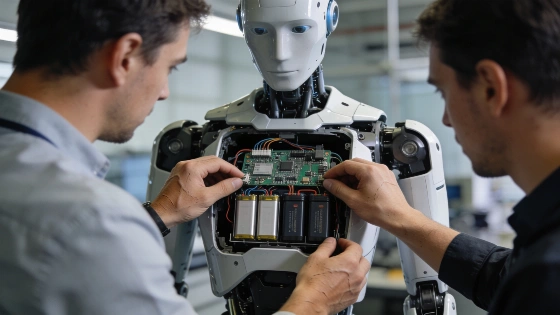
Most humanoid robots rely on lithium-ion battery packs or, less commonly, onboard fuel cells to supply electrical energy. The available energy must be converted to multiple voltage levels and distributed to motors, controllers, sensors, and communication modules. Power conversion modules-such as those developed by companies like Murata Power Solutions-are responsible for transforming battery output into the precise forms required by each subsystem. Inefficiencies at any stage, from conversion losses to distribution bottlenecks, reduce the robot's operational time and can lead to overheating, voltage drops, or unexpected shutdowns.
Engineering Trade-Offs
Designers must balance competing demands for compactness, weight, efficiency, and thermal management. High-efficiency power modules can extend battery life but may add weight or require additional cooling. Conversely, lighter systems may sacrifice reliability or limit peak performance. In practice, most humanoid robots operate for less than two hours on a single charge, with actual runtime depending on the intensity of movement and computational load. For example, a typical mid-sized humanoid may carry a 1 kWh battery, but only a fraction of that energy is available for locomotion after accounting for conversion losses and idle consumption.
Power failures or voltage instability can have immediate safety implications, especially when robots interact with people or handle heavy objects. To mitigate these risks, engineers implement redundant power paths, real-time monitoring, and emergency shutdown protocols. However, these safety features further increase system complexity and energy overhead. The need for robust power management also complicates regulatory certification, as standards for electrical safety and electromagnetic compatibility must be met in addition to functional performance requirements.
Limits on Autonomy and Deployment
Current power management technology imposes strict limits on the autonomy and deployment of humanoid robots. Most systems require frequent recharging or battery swaps, restricting their use in continuous or mission-critical applications. In industrial and medical settings, robots may be tethered to external power sources or operated in short bursts to avoid mid-task failures. The challenge is particularly acute for robots intended to work alongside humans, where unpredictable power loss could create unacceptable hazards.
Efforts to improve power density, conversion efficiency, and thermal management are ongoing, but progress is incremental. Developers are exploring advanced battery chemistries, more efficient power electronics, and adaptive control algorithms that optimize energy use based on real-time task demands. However, each improvement introduces new engineering trade-offs and potential failure modes that must be carefully evaluated before deployment in safety-critical environments.
According to a report from The Robot Report, companies such as Murata Power Solutions are focusing on compact, high-efficiency power modules designed for robotics and other demanding applications. While these advances have enabled more capable prototypes, no current system has eliminated the need for careful power budgeting, continuous monitoring, and human oversight during operation.
Power management remains a central engineering constraint for humanoid robots. Until significant advances are made in energy storage and conversion, the capabilities, safety, and deployment of these machines will be defined as much by their power systems as by their mechanical or software design.
Understanding power management in robotics requires attention to both hardware and software. Power conversion modules transform battery output into the voltages and currents needed by different robot subsystems, while software monitors consumption and triggers safety responses. Even small inefficiencies can accumulate, reducing runtime and increasing heat. Engineers must design for worst-case loads, account for battery aging, and ensure that emergency shutdowns do not create new hazards. Effective power management is not just a technical detail-it is a prerequisite for reliable, safe, and scalable humanoid robot deployment.