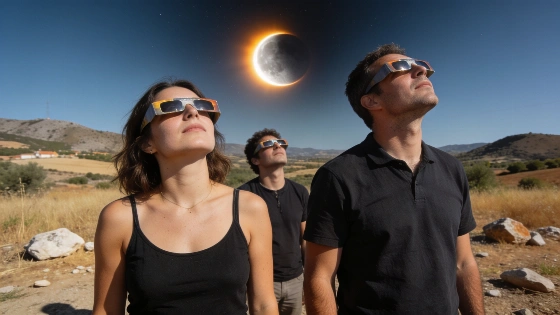
On August 12, 2026, a total solar eclipse will cross parts of Europe and the Arctic, offering a rare opportunity to observe the Sun's atmosphere and dynamic eclipse phenomena as the Moon's shadow sweeps across Earth's surface
On August 12, 2026, a total solar eclipse will unfold across a narrow corridor stretching from Spain through Iceland and Greenland, providing millions with a rare opportunity to witness the Sun's light dramatically obscured by the Moon. This event, occurring during the new moon phase, will allow observers within the path of totality to experience a brief period of darkness in daytime, while those outside this path will see a partial eclipse. The precise sequence of eclipse stages reveals both the mechanics of celestial alignment and the limits of direct solar observation from Earth's surface.
The Partial Eclipse Begins
The eclipse commences with the partial phase, known as first contact, when the Moon's disk first appears to touch the Sun. For this event, first contact will be visible over Alaska at 11:34 a.m. EDT (15:34 UTC), with the shadow then progressing eastward. Over the next 90 minutes, the Moon will cover an increasing portion of the Sun, transforming its appearance from a full disk to a narrowing crescent. As the eclipse deepens, observers may notice a perceptible drop in temperature and a gradual dimming of daylight, especially in the half hour before totality. Pinhole projections-such as sunlight passing through leaves or small apertures-will cast crescent-shaped images, mirroring the Sun's changing form.
Throughout the partial phases, direct viewing of the Sun remains hazardous without proper eye protection. Specialized eclipse glasses or solar filters are essential to prevent permanent eye damage. The degree of obscuration will vary by location, and interactive tools are available to help observers determine the timing and extent of the eclipse from their vantage point.
Approaching and Entering Totality
As the Moon's coverage nears completion, several striking visual effects emerge. The "diamond ring" effect occurs when a final bright point of sunlight shines through a lunar valley, briefly resembling a sparkling jewel. Moments later, "Baily's beads"-caused by sunlight streaming through the Moon's rugged topography-appear as points of light along the lunar limb. Observers may also notice the Moon's shadow racing across the landscape, plunging the environment into an artificial twilight.
Totality begins when the Moon fully covers the Sun's photosphere, revealing the solar corona-a faint, extended halo of superheated plasma. This phase will last up to 2 minutes and 18 seconds at maximum, depending on the observer's position within the path of totality. During totality, it is safe to view the Sun directly without filters, but eye protection must be replaced as soon as the Sun's bright surface reemerges.
Maximum Eclipse and the Return of Daylight
At the midpoint of totality, the Sun is most completely hidden, and the corona becomes most prominent. The chromosphere, a thin reddish layer beneath the corona, may be visible for a few seconds at the beginning and end of totality. Bright planets such as Venus, Jupiter, and Mercury may become visible near the eclipsed Sun, and the timing coincides with the peak of the Perseid meteor shower, offering a chance-though not a guarantee-to spot a meteor in the darkened sky.
As totality ends, the sequence of visual effects reverses: Baily's beads and the diamond ring reappear as sunlight returns, and the Sun gradually emerges from behind the Moon. The partial phase continues until the Moon's silhouette fully departs the Sun's disk, marking fourth contact. For this eclipse, the final phase concludes at 3:57 p.m. EDT (19:57 UTC) over the Atlantic, west of Africa.
Observing and Interpreting the Eclipse
The 2026 total solar eclipse offers a unique opportunity for both professional and amateur astronomers to study the Sun's outer atmosphere and dynamic eclipse phenomena. Observers in Spain, Iceland, and Greenland will have the best chance to experience totality, while millions more across Europe and the Arctic will witness a partial eclipse. For those unable to travel, live online coverage and expert commentary will be available, with expeditions organized to capture the event from land and sea. The path and timing of the eclipse are shaped by the geometry of the Moon's orbit and Earth's curvature, a topic explored in detail in analyses such as how map projections affect the apparent motion of the eclipse shadow.
Photographers and skywatchers are encouraged to use appropriate solar filters and plan their observations carefully. The fleeting nature of totality and the rapid progression of eclipse stages demand precise timing and preparation. As with all astronomical events, weather and local conditions will play a significant role in what can be observed from any given location.
Understanding a total solar eclipse requires familiarity with the interplay of orbital mechanics and observational geometry. The Moon's orbit is tilted relative to Earth's, so total eclipses occur only when the Sun, Moon, and Earth align closely enough for the Moon's shadow to reach the surface. The path of totality is a narrow band where the alignment is exact, while regions outside this path experience only a partial eclipse. The corona, normally invisible due to the Sun's brightness, becomes observable only during totality, offering rare insight into solar atmospheric structure and dynamics.