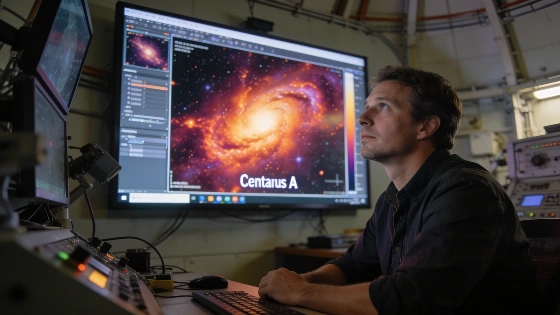
NASA's James Webb Space Telescope has captured a detailed mid-infrared image of Centaurus A, revealing complex dust lanes and energetic activity in this nearby galaxy using its MIRI instrument
Centaurus A, one of the closest active galaxies to Earth, has been imaged in unprecedented detail by NASA's James Webb Space Telescope (JWST) using its Mid-Infrared Instrument (MIRI). The new observations, recorded on July 6, 2026, provide a sharp view of the galaxy's intricate dust structures and energetic core, offering fresh insight into the processes shaping this unusual system.
Mid-Infrared Imaging and Instrumentation
The JWST's MIRI instrument is designed to detect mid-infrared wavelengths, which are particularly effective at penetrating dust that obscures visible light. By observing Centaurus A in this regime, astronomers can trace the distribution of dust and gas, as well as identify regions of star formation and energetic activity near the galaxy's center. The resulting image reveals a complex network of dust lanes and bright knots, some of which are associated with the galaxy's active nucleus.
Centaurus A is located approximately 11 million light-years from Earth, making it a relatively nearby target for detailed study. Unlike most galaxies at this distance, Centaurus A is classified as a radio galaxy, with a supermassive black hole at its core that powers jets and outflows visible across the electromagnetic spectrum. The mid-infrared data from JWST allow researchers to separate emission from dust, stars, and the active galactic nucleus, providing a clearer picture of the physical processes at work.
Scientific Insights from the New Data
The MIRI observations highlight the turbulent environment near Centaurus A's center, where dust lanes twist around the nucleus and obscure direct optical views. These features are thought to be the result of a past merger between galaxies, which disrupted the system and funneled gas toward the central black hole. The mid-infrared image also reveals regions of intense star formation, as well as evidence of feedback from the active nucleus shaping the surrounding interstellar medium.
By mapping the distribution of dust and energetic regions, astronomers can test models of galaxy evolution and black hole growth. The data suggest that Centaurus A's current activity is closely linked to its merger history, with the inflow of gas fueling both star formation and accretion onto the central black hole. This makes Centaurus A a valuable laboratory for studying the interplay between galactic dynamics and nuclear activity.
Context and Ongoing Research
The new JWST image of Centaurus A builds on decades of multiwavelength observations, including radio, optical, and X-ray studies. Each wavelength regime reveals different aspects of the galaxy's structure and activity. The mid-infrared view from MIRI complements these datasets by exposing features hidden by dust in other bands. Researchers are now combining the JWST data with previous observations to construct a more complete model of the galaxy's evolution and current state.
Centaurus A's proximity and activity have made it a frequent target for astronomers seeking to understand the relationship between supermassive black holes and their host galaxies. For comparison, recent studies of other nearby stellar systems, such as the direct imaging of Betelgeuse's companion star using the Very Large Telescope, have also advanced our understanding of complex astrophysical environments. Readers interested in how high-resolution imaging is transforming our view of the cosmos can explore related findings in this report on Betelgeuse's companion star.
Centaurus A remains a key object for testing theories of galaxy mergers, black hole fueling, and feedback processes. As JWST continues its mission, further observations are expected to refine our understanding of how such active galaxies evolve over cosmic time.
To interpret the new image of Centaurus A, it is important to understand how mid-infrared astronomy works. Infrared wavelengths are less affected by dust than visible light, allowing astronomers to peer into regions that would otherwise be hidden. Instruments like JWST's MIRI use sensitive detectors cooled to very low temperatures to minimize background noise and capture faint signals from distant galaxies. By analyzing the spatial distribution and spectral properties of the infrared emission, researchers can distinguish between different sources of light-such as stars, dust, and active galactic nuclei-and reconstruct the physical conditions within complex systems like Centaurus A.