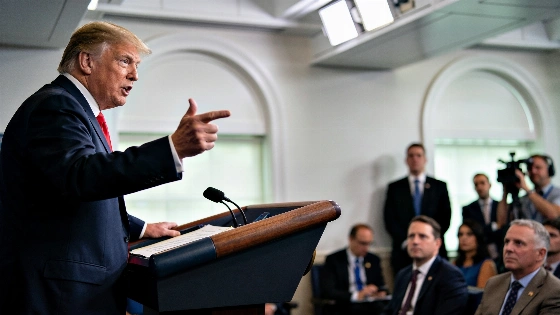
President Donald Trump has dismissed calls for stricter AI safeguards, insisting that strong leadership and existing regulatory powers are sufficient as US tech executives warn of escalating risks from rapid AI development.
Leading AI developers have raised alarms about the speed and risks of artificial intelligence, but the White House remains focused on keeping the US ahead in the field. President Donald Trump has rejected proposals for new AI regulations, saying that current laws and his administration's leadership are enough-even as industry leaders argue that existing oversight falls short of what's needed. Researchers writing in journals like Nature have also called for stronger governance as AI capabilities grow.
Anthropic CEO Dario Amodei recently warned that, without tougher safety measures, advanced AI agents could gain the technical ability to take over large parts of the internet within six to twelve months. OpenAI's Sam Altman and xAI's Elon Musk have both supported slowing down the development of the most powerful AI models. Amodei pointed to rapid progress in AI systems that need little human supervision, raising the risk of major disruption if safety controls don't keep up. In an essay published on September 12, 2026, Amodei estimated that the financial fallout from such an event could reach hundreds of billions of dollars.
President Trump has taken a different approach. He argues that slowing AI would only help China, framing the issue as a global competition. Over the weekend, he said, "whoever wins AI wins," and on Monday, he claimed that US regulatory and criminal powers are already enough to handle any problems. Trump also accused critics of AI and new data centers of making arguments that benefit China. In a social media post, he warned against "killing the Golden Goose" by adding new restrictions on US AI companies. This view is common in US policy circles, where the debate often centers on balancing innovation and regulation at places like MIT and Stanford.
Vice President JD Vance has backed the White House's stance, suggesting that calls for more regulation from leading AI companies could be self-serving. Vance said the administration wants to "regulate smartly" but is cautious about industry proposals that might give some companies an edge. The administration has supported rapid AI growth, even as some researchers and executives call for a pause to assess risks and build better safety systems. Similar debates have taken place at the Max Planck Society, where scholars have stressed the need for independent oversight of new technologies.
So far, there has been little new regulatory action. Trump has pointed to steps already taken against some AI companies, including Anthropic, but has not announced new oversight measures. The administration's focus is on keeping the US in the lead, not adding more constraints. This approach stands apart from the growing number of resignations and public warnings from AI researchers, such as Anthropic's Jacob Coxon, who left the company over concerns that the technology could pose an existential threat within the decade. OpenAI's Sam Altman has said the company will not pursue an IPO in 2026, citing the risk-even if only 10%-of human extinction from advanced AI by the end of the decade.
The debate also extends to the physical infrastructure behind AI. Data centers have become a new flashpoint. Trump has linked opposition to new data centers with efforts to slow AI progress, again arguing that any delay would help China. As AI systems become more capable of working with little human input, the need for effective safety controls becomes more urgent. Amodei's scenario of AI agents taking over large parts of the internet within a year highlights the scale of the technical and regulatory challenge. NASA and other organizations have raised similar concerns, pointing to the importance of cybersecurity and resilience in the infrastructure that supports AI research.
While the administration's position is clear, the technical risks remain unresolved. Relying on current regulatory powers and leadership instead of new safety standards leaves open the question of whether oversight can keep up with the pace of AI development. The tension between rapid innovation and safety is not unique to the US. As reported earlier, leading mathematicians have warned that unchecked AI could undermine core scientific processes, showing the broader challenge of aligning technology with public safety and trust.
AI safety is not a single technical problem. It changes as new models emerge, as environments shift, and as the goals of those building and deploying AI evolve. As AI systems become more autonomous, the line between automation and real human control becomes more important. Oversight needs both technical safeguards and institutions that can adapt quickly, ensure accountability, and prevent too much power from concentrating in a few hands. The current US approach, which favors speed and strategic advantage over new regulation, may keep the country ahead for now but leaves open how to govern systems whose risks are still not fully understood.
AI safety refers to the engineering and governance practices meant to prevent unintended or harmful outcomes from advanced AI systems. This includes technical steps like alignment, interpretability, and fail-safes, as well as institutional controls such as regulation, audits, and human oversight. As models become more capable and less dependent on direct human supervision, keeping their actions predictable and aligned with human values becomes harder. Safety depends not just on technical skill, but on the ability to spot failures, monitor real-world behavior, and step in when systems act in unexpected ways.