A 55-acre project in Salida, Colorado, is deploying autonomous 3D-printing robots to construct more than 65 homes, testing whether robotic construction can deliver full-scale residential communities with integrated infrastructure
One of the largest planned deployments of robotic construction in the United States is underway in Salida, Colorado, where the Cleora development is using autonomous 3D-printing systems to build more than 65 residential homes. The project, spanning 55 acres, is managed by Cleora in partnership with 3D-printing contractor True North and technology provider RIC Robotics. The initiative aims to move robotic construction beyond isolated prototypes and into the realm of full-scale, functioning neighborhoods.
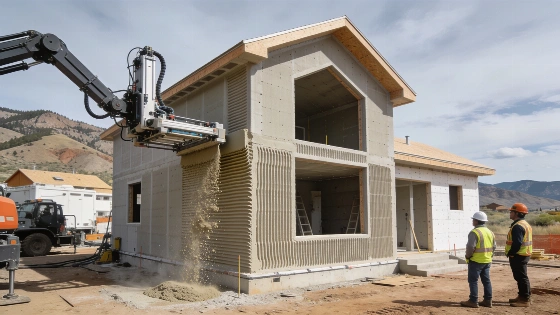
At present, two autonomous RIC Robotics printing systems are operating on site, fabricating the structural shells of homes using additive manufacturing techniques. The first model home, constructed by True North, is expected to have its shell completed within the month. The development team plans to expand production incrementally, monitoring system performance and reliability as the scale increases. Most previous 3D-printed housing efforts have focused on single homes or small demonstration projects, making Cleora a significant test of whether robotic systems can be integrated into a larger, operational community.
Deployment Scale and Technical Details
The Cleora project is designed to include over 65 homes, all constructed using RIC Robotics' autonomous 3D-printing platforms. These systems operate with minimal direct human intervention during the printing process, though human oversight remains necessary for setup, maintenance, and quality assurance. The development also features its own metropolitan district, which will manage water treatment, utilities, recreation, and commercial facilities. This integrated approach is intended to test not only the technical feasibility of robotic construction at scale, but also the practical challenges of infrastructure management and community operation.
While the company has not disclosed detailed performance metrics or independent evaluations, the scale of the planned deployment is notable. The project will serve as a live testbed for assessing construction speed, cost control, and architectural variety when using autonomous systems. The gradual ramp-up allows developers to identify and address technical failures, system bottlenecks, and integration issues as they arise, rather than relying solely on laboratory or small-scale demonstration data.
Workforce Training and Community Integration
In addition to construction, Cleora is partnering with Colorado Mountain College to establish a training hub for students in construction robotics, 3D-printing systems, and digital design. This collaboration is intended to provide hands-on experience with emerging construction technologies and support the development of new training programs and certifications. The goal is to prepare workers for roles in an industry that is expected to become increasingly automated, while also addressing workforce shortages in the construction sector.
The project's metropolitan district structure is the first in the county to be based on 3D-printed infrastructure. By combining robotic homebuilding, workforce training, and integrated services, Cleora is testing whether a repeatable model for technology-driven community development can be established. However, the long-term reliability, cost-effectiveness, and social acceptance of such systems remain to be demonstrated through ongoing operation and independent evaluation.
Limitations and Open Questions
Despite the scale of the Cleora project, several limitations are apparent. The current evidence is based on company-reported progress and early-stage deployment, with no independent audit or peer-reviewed evaluation of construction quality, speed, or cost. Human oversight is still required for system setup, monitoring, and intervention in case of failure. The ability of autonomous 3D-printing systems to maintain architectural diversity and meet regulatory standards at community scale has not yet been established. Additionally, the integration of robotic construction with essential infrastructure and services introduces new coordination and safety challenges that have not been fully addressed in previous projects.
Cleora's approach may offer insights into addressing persistent challenges in the construction sector, such as labor shortages and the difficulty of scaling new building methods. However, the project's outcomes will depend on the reliability of the robotic systems, the effectiveness of workforce training, and the adaptability of regulatory and institutional frameworks to new construction technologies.
Robotic construction refers to the use of automated or semi-automated machines to perform building tasks traditionally handled by human workers. In the context of 3D-printed housing, robots deposit layers of construction material-often concrete or composite mixtures-according to digital blueprints. While these systems can reduce manual labor and potentially speed up construction, they require careful calibration, ongoing maintenance, and human oversight to ensure safety and quality. The distinction between automation and full autonomy is critical: most current systems operate with significant human involvement, especially during setup, supervision, and error recovery. The transition from laboratory demonstration to reliable field deployment remains a central challenge for the sector.