QYSEA's FIFISH V6 EXPERT costs $3,499 and is rated to dive 100 meters. Its tethered camera platform records 4K footage, while optional tools support small-object retrieval; performance depends on fitted accessories and underwater conditions
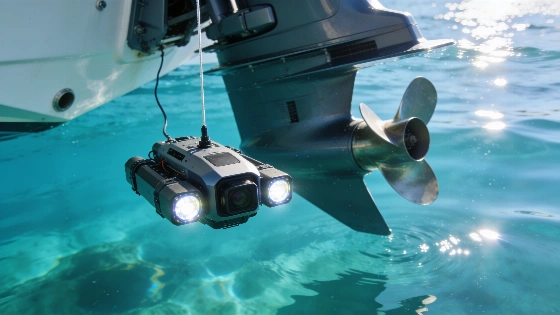
A rope caught around a propeller can be hard to assess from the deck, especially when the damage sits below the waterline. QYSEA's FIFISH V6 EXPERT lets an operator send a camera-equipped vehicle down from the surface to inspect the area without entering the water.
The tethered remotely operated vehicle is priced at $3,499 and rated for depths up to 100 meters (328 feet). It can move in six directions and rotate without turning around, while QYSEA lists its maximum speed as 3 knots (1.5 meters per second). This is remote operation, not an autonomous inspection: a person controls the vehicle through a surface controller.
Remotely operated vehicles are used to inspect vessel hulls and propellers as well as ports, offshore wind assets, and oil-and-gas facilities. Intertek describes industrial ROV inspections that combine high-resolution video with sonar, navigation, dynamic positioning, and non-destructive testing to assess asset integrity, corrosion, and seabed clearance. Commercial vessel operators also use ROVs to look for ropes, fishing nets, marine growth, corrosion, and possible damage after an incident; Marlow Offshore says this can provide quick visual checks of hard-to-reach areas.
Its camera records 4K video at 25 or 30 frames per second. For slower-motion footage, it can capture 1080p at up to 120 frames per second. Two LED lights provide a combined 6,000 lumens, and removable microSD storage includes a 128GB card, with support for cards up to 256GB.
Onboard sensors include a gyroscope, accelerometer, magnetometer, depth sensor and temperature sensor. QYSEA says its depth-lock feature can hold a selected depth to approximately ±1 centimeter. The battery is rated for about one to four hours of operation, depending on conditions; the company also advertises charging to 90 percent in about an hour.
A tether connects the ROV to its controller. Available cable lengths are 100 meters and 200 meters, and the cable has neutral buoyancy underwater. An optional surface power system can support longer operations without relying entirely on the onboard battery.
The Q-IF interface allows users to fit tools for different jobs. Options include a parallel-gripper arm for retrieving small objects, a hook and imaging sonar for poor visibility; measurement devices and water-quality sensors are also available. The Federal Highway Administration describes ROVs as self-propelled underwater video platforms that can carry instruments or manipulators. Its underwater inspection manual notes that ROV inspections are generally best suited to areas with limited current and recommends real-time depth and direction information to help operators maintain their orientation around a structure. Inspection robotics also includes machines intended for hazardous industrial sites, covered in Science Report's earlier robotics report; the underwater vehicle here is tethered and remotely operated.
Remote inspection can also serve as an initial assessment before deciding whether divers need to enter the water. Franmarine representative Adam Falconer-West described that approach to Deep Trekker as a way to reduce diver exposure to hazardous underwater conditions. Intertek likewise describes ROVs as tools for inspecting hard-to-access assets while limiting personnel exposure.
The arm's usefulness depends on the accessory fitted, while visibility and operating conditions affect what the camera can show. The supplied specifications do not establish inspection success rates or performance across different underwater environments.