Postquant Labs has released QuipSwap, a protocol for cross-chain asset swaps that removes bridges, oracles, and wrapped tokens, aiming to reduce vulnerabilities and address quantum decryption risks in blockchain transactions
Postquant Labs has announced the public launch of QuipSwap, a protocol designed to enable cross-chain asset swaps without relying on traditional bridges, oracles, or wrapped tokens. The protocol, developed in collaboration with quip.network, is intended to address longstanding vulnerabilities in decentralized finance (DeFi) infrastructure, particularly those associated with bridge-based asset transfers and the emerging threat of quantum decryption against legacy cryptographic signatures.
Protocol Architecture
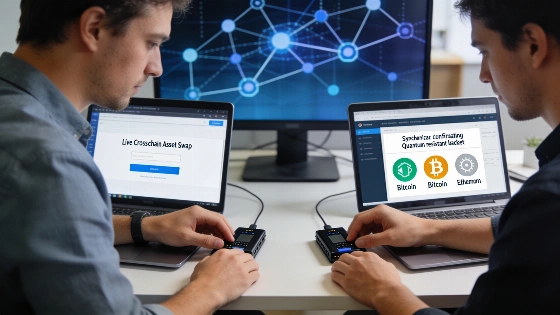
QuipSwap's architecture is built around a bridgeless, trustless mechanism for exchanging assets directly between blockchains. Unlike conventional cross-chain protocols that depend on smart contract bridges or third-party custodians to lock assets and issue wrapped tokens, QuipSwap implements a synchronized atomic key exchange. In this model, counterparties agree to a trade and exchange wallet access directly across chains. When one party claims their side of the transaction, the protocol ensures the counterparty automatically receives their corresponding claim key, enabling an atomic swap without intermediary custody. This approach is designed to eliminate central storage points that have been repeatedly targeted in DeFi exploits.
Quantum-Resistant Implementation
The protocol's developers have prioritized quantum resistance, citing the risk that future quantum computers could compromise widely used public-key cryptographic schemes such as ECDSA. To address this, Postquant Labs has deployed beta versions of quantum-resistant wallets for Bitcoin, Ethereum, and Solana. These wallets are intended to allow users to retain native assets on their respective chains while interacting with post-quantum workflows. The protocol's codebase underwent a formal security audit by Oak Security following a live demonstration at ETHDenver, and the architecture is open source to facilitate independent review.
Security and Audit Status
QuipSwap's design removes several common attack vectors by eliminating wrapped assets, liquidity pools, and oracles. The protocol's atomic claim key mechanism is intended to prevent the accumulation of assets in a single contract or wallet, reducing the risk of large-scale theft in the event of a vulnerability. The Oak Security audit, completed prior to public release, focused on the core codebase and its implementation of atomic swaps and quantum-resistant wallet integration. However, as with any new protocol, the absence of long-term operational data means that real-world resilience against both classical and quantum attacks remains to be established.
Context and Remaining Challenges
QuipSwap's launch comes amid growing industry concern about the security of cross-chain protocols and the timeline for practical quantum attacks on blockchain infrastructure. While the protocol's bridgeless design and quantum-resistant wallet deployment represent a technical advance, the broader challenge of migrating existing blockchain systems to post-quantum security standards remains unresolved. Recent efforts in other regions, such as India's deployment of quantum-secure devices for telecom and finance, highlight the global push to address quantum-era risks in critical infrastructure. For example, India's national program has begun integrating quantum cryptography and post-quantum standards into its telecom and financial networks, as described in Science Report's coverage of India's quantum-secure device rollout.
Atomic swaps are a cryptographic protocol that enables two parties to exchange assets across different blockchains without relying on a trusted intermediary. The process uses a combination of time-locked and hash-locked contracts to ensure that either both parties receive their agreed assets or neither does, preventing unilateral loss. In the context of quantum computing, the security of atomic swaps depends on the underlying cryptographic primitives. As quantum computers advance, protocols must transition to quantum-resistant algorithms to maintain the integrity of cross-chain transactions and protect against future decryption threats.