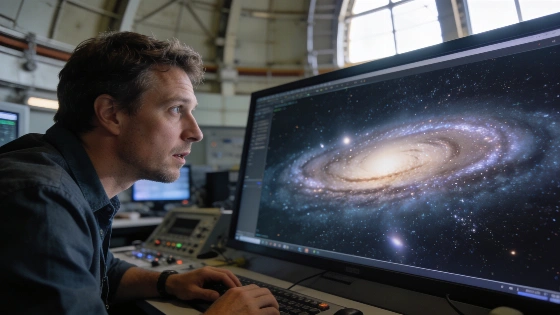
Supercomputer simulations suggest the Milky Way's spiral disk may have rotated by 90 degrees in the distant past, potentially changing the solar system's path and explaining the galaxy's unusually slow stellar halo rotation
New computational models indicate that the Milky Way's spiral disk may have experienced a dramatic reorientation in its history, with the disk flipping by as much as 90 degrees. This scenario, supported by recent supercomputer simulations, could explain why the galaxy's stellar halo rotates more slowly than the disk itself-a longstanding puzzle in galactic astronomy.
Simulations Reveal Disk Flips
Researchers led by Kirill Batrakov at the University of Durham used high-resolution simulations to track the evolution of 25 galaxies similar to the Milky Way over billions of years. Their models incorporated the effects of galactic mergers and gravitational interactions, allowing them to observe how these events influence the structure and motion of stars. The simulations showed that galaxies with slowly rotating stellar halos often experienced either a major merger or a significant disk flip, or both, during their evolution.
In the case of the Milky Way, the evidence points to a major collision with a dwarf galaxy known as Gaia-Sausage-Enceladus between 8 and 11 billion years ago. This event, previously identified through stellar motion data from the European Space Agency's Gaia mission, contributed a large population of stars to the Milky Way's halo. The simulations suggest that such a merger can disrupt the disk's orientation, potentially causing it to flip relative to the surrounding halo.
Consequences for the Solar System
If the Milky Way's disk did flip after the formation of the solar system, the sun and its planets would have experienced a significant change in their orbital path around the galactic center. The models indicate that a disk flip alters the trajectories of most stars in the disk, meaning the solar system's current orbit may differ substantially from its original path. This raises questions about the long-term stability of the solar neighborhood and the broader implications for planetary systems embedded in galactic disks.
The simulations also reveal that not all disk flips are triggered by mergers. Some galaxies in the study underwent disk reorientations without a clear external collision, suggesting that internal dynamical processes or minor interactions could also drive such events. The precise mechanism responsible for the Milky Way's disk flip remains uncertain, and further investigation is needed to distinguish between competing scenarios.
Stellar Halo Rotation and Galactic History
The slow rotation of the Milky Way's stellar halo has been a subject of debate since it was first measured by the Gaia mission. In the simulations, both major mergers and disk flips contribute to this phenomenon. When a galaxy like Gaia-Sausage-Enceladus merges with the Milky Way, its stars are deposited into the halo on orbits that are often misaligned with the disk, resulting in a halo that rotates more slowly relative to the disk's new orientation. A disk flip can further increase this misalignment, as the halo does not immediately adjust to the disk's new plane.
These findings add complexity to the narrative of the Milky Way's formation and evolution. They also highlight the importance of reconstructing galactic histories from present-day observations, a process that relies on both detailed simulations and precise measurements of stellar motions. For context, astronomers have previously used X-ray data to study how black hole jets can disrupt early galaxies, as seen in this analysis of a distant galaxy's gas dynamics.
Limits and Open Questions
While the simulations provide a plausible explanation for the Milky Way's slow-rotating halo and possible disk flip, they do not establish the exact timing or mechanism of the event. The models show that both mergers and internal processes can produce similar outcomes, but distinguishing between these scenarios for the Milky Way requires further observational evidence. The current results are based on simulated galaxies and must be tested against additional data from ongoing and future surveys.
Much of what is known about the Milky Way's past comes from indirect evidence, such as the motions and chemical compositions of stars. As new data from missions like Gaia continue to refine our understanding, astronomers hope to clarify the sequence of events that shaped the galaxy's present structure and the solar system's place within it.
To understand how astronomers reconstruct the Milky Way's history, it is important to recognize the role of stellar kinematics-the study of star motions. By measuring the velocities and trajectories of stars using precise astrometric data, researchers can infer past interactions, mergers, and structural changes in the galaxy. These measurements, combined with advanced simulations, allow scientists to test different evolutionary scenarios and assess their consistency with observed properties such as halo rotation and disk orientation. However, the interpretation of these data depends on the accuracy of the models and the completeness of the observational sample, making this a continually evolving field.