On August 14, 1992, a large meteoroid entered Earth's atmosphere above Mbale, Uganda, breaking apart and scattering hundreds of meteorite fragments across the region. Scientists later analyzed the debris to study its composition and impact effects
On August 14, 1992, residents of Mbale, Uganda witnessed a rare and scientifically significant event when a meteoroid entered Earth's atmosphere and fragmented, dispersing hundreds of meteorite pieces across the local landscape. The event provided researchers with a unique opportunity to study the immediate aftermath of a meteorite fall in a populated area, as well as the physical properties of the recovered material.
Fragmentation and Recovery
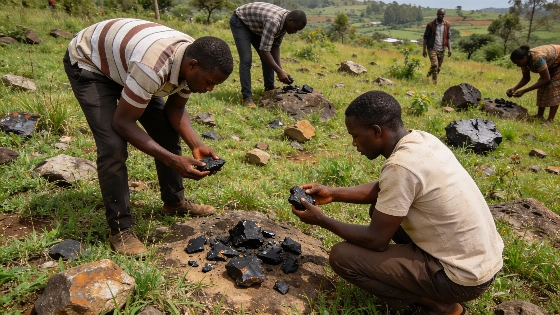
The meteoroid, estimated to have originally weighed over 900 kilograms, broke apart at altitudes between 25 and 10 kilometers above the ground. The resulting meteorite shower scattered debris over an area approximately 3.2 by 6.4 kilometers. The largest recovered fragment weighed more than 27 kilograms, while hundreds of smaller pieces were collected by local residents and scientific teams. Notably, a young boy was struck on the head by a small fragment, but no serious injuries were reported.
By October 1993, researchers had cataloged 863 individual fragments, with a total surviving mass estimated at 150 kilograms. The rapid recovery of these pieces-some within days of the fall-enabled detailed laboratory analysis, including radionuclide studies that benefit from minimal terrestrial contamination. The event's scale and the speed of recovery made it a valuable case for understanding the distribution and preservation of meteorite material after atmospheric entry.
Scientific Classification and Analysis
NASA classified the Mbale meteorite as an L5/6 ordinary chondrite, a type of stony meteorite that preserves information about the early solar system. Laboratory studies focused on the mineralogy, isotopic composition, and radionuclide content of the fragments. These analyses help constrain the meteorite's exposure history in space and its thermal evolution before reaching Earth. The classification also aids in comparing Mbale's material with other known meteorite falls and with samples collected by planetary missions.
Fragments from the Mbale event have occasionally appeared in public auctions, reflecting ongoing interest in their scientific and historical value. In October 2012, for example, a piece was offered for sale in New York City, highlighting the intersection of scientific research and private collecting. The Mbale fall remains one of the most thoroughly documented meteorite showers in Africa, with its rapid recovery and detailed study contributing to the broader understanding of meteoritic processes.
Impact on the Local Community
The Mbale meteorite fall had a direct impact on the local population, both as a physical event and as a subject of scientific attention. While the majority of fragments landed harmlessly, the incident underscored the unpredictable nature of meteoroid entries over inhabited regions. The event also provided an opportunity for collaboration between local residents and scientific teams, who worked together to recover and document the fragments.
Similar meteorite events have occurred elsewhere, such as the dramatic outburst of comet 220P/McNaught observed over Namibia, which was captured by astrophotographers and documented in a recent Science Report feature. These events collectively inform planetary defense strategies and public awareness of near-Earth objects.
Atmospheric Entry and Breakup
Analysis of the Mbale event indicates that the meteoroid's breakup occurred at high altitude, with the majority of its mass ablated or fragmented before reaching the ground. The distribution of fragments and their physical characteristics provide data for modeling the mechanical stresses and thermal effects experienced during atmospheric entry. Such models are essential for predicting the outcomes of future meteoroid encounters and for assessing the risks posed by larger objects.
Although the Mbale meteorite fall did not result in significant damage or casualties, it serves as a reminder of the ongoing flux of extraterrestrial material entering Earth's atmosphere. The event's documentation and subsequent research continue to inform both planetary science and public safety considerations.
To understand the significance of meteorite classification, it is important to recognize that chondrites like the Mbale fragments are among the most primitive materials in the solar system. Their mineralogy and isotopic signatures preserve records of early solar nebula processes, parent body alteration, and cosmic ray exposure. Laboratory analysis of freshly recovered meteorites allows scientists to minimize terrestrial alteration, improving the reliability of their findings. The study of meteorite falls such as Mbale thus provides a direct link to the solar system's formative history and the ongoing delivery of material to Earth's surface.