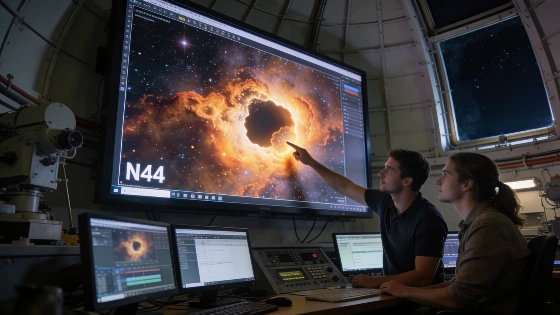
A new Hubble Space Telescope image captures the nebula N44 in the Large Magellanic Cloud, highlighting a vast superbubble at its center and offering fresh insight into the impact of massive stars on their galactic environment
Astronomers using the Hubble Space Telescope have captured a detailed image of the nebula N44 in the Large Magellanic Cloud, revealing a vast, nearly empty cavity at its heart. This so-called superbubble, stretching roughly 210 by 140 light-years, stands out as one of the most prominent features in the region and raises new questions about the life cycles of massive stars and the forces that shape interstellar gas.
Superbubble Structure and Scale
N44, located about 160,000 light-years from Earth in the constellation Dorado, is classified as an emission nebula-a region where energetic young stars ionize surrounding gas, causing it to glow. The most striking aspect of the new Hubble image is the central void, a superbubble whose size dwarfs the entire Solar System. For comparison, the distance from the Sun to Pluto is less than a single light-year, while the N44 cavity spans hundreds of times that scale. The nebula's shell is dotted with newly formed stars, visible as luminous points against the diffuse background.
Superbubbles like the one in N44 are thought to form when stellar winds from massive stars, and possibly multiple supernova explosions, sweep away gas and dust from the central region. This process leaves behind a low-density cavity surrounded by a shell of compressed material. The precise contribution of winds versus supernovae remains under investigation, and N44's structure provides a valuable laboratory for testing these models.
Hubble's Observational Role
The Hubble Space Telescope's imaging capabilities allow astronomers to resolve fine details in nebulae like N44, distinguishing individual stars and tracing the structure of ionized gas. In this observing campaign, Hubble surveyed nearly half a million stars in and around the nebula, including about 30,000 in the earliest stages of formation. The data reveal not only the scale of the superbubble but also the ongoing process of star birth within the surrounding shell.
Emission nebulae such as N44 are powered by the ionization of gas, primarily hydrogen, by ultraviolet radiation from hot, young stars. As the gas cools and recombines, it emits light at characteristic wavelengths, producing the nebula's distinctive glow. The Hubble image combines exposures in multiple filters to highlight these features, though the colors are mapped to emphasize physical processes rather than to represent true visual appearance.
Physical Mechanisms and Open Questions
The formation of superbubbles is a key aspect of stellar feedback-the process by which stars inject energy and momentum into their environment. In N44, the evidence points to a combination of strong stellar winds and past supernovae as the primary drivers of the cavity. However, the relative importance of each mechanism is still debated. X-ray observations from the Chandra X-ray Observatory have previously detected shock-heated gas in the region, supporting the idea that supernova remnants contribute to shaping the nebula's structure.
Despite decades of study, the detailed evolution of superbubbles remains uncertain. The interplay between stellar winds, supernovae, and the surrounding interstellar medium is complex, and N44's size and morphology offer a rare opportunity to test theoretical models. Similar questions about the impact of energetic processes on galactic environments have been raised in reported earlier studies of black holes and early galaxy evolution.
Implications for Star Formation
The shell of N44 is not a static structure. Observations indicate that star formation continues within the compressed gas surrounding the superbubble, with new stars emerging as the region evolves. This feedback-driven cycle-where massive stars disrupt their birth clouds, triggering further star formation in the process-is a central theme in understanding how galaxies evolve over time.
By mapping the distribution and properties of young stars in N44, astronomers can probe the efficiency of star formation in environments shaped by intense feedback. The nebula's location in the Large Magellanic Cloud, a satellite galaxy of the Milky Way, provides a valuable external perspective on these processes, complementing studies of similar regions within our own galaxy.
Superbubbles are large cavities in the interstellar medium created by the combined action of stellar winds and supernova explosions from clusters of massive stars. These structures can span hundreds of light-years and play a crucial role in redistributing energy and material within galaxies. By compressing surrounding gas, superbubbles can trigger new waves of star formation, while also clearing out regions and influencing the chemical evolution of their host galaxies. Observing and modeling superbubbles helps astronomers understand the balance between star formation and feedback, a fundamental process in galactic evolution.