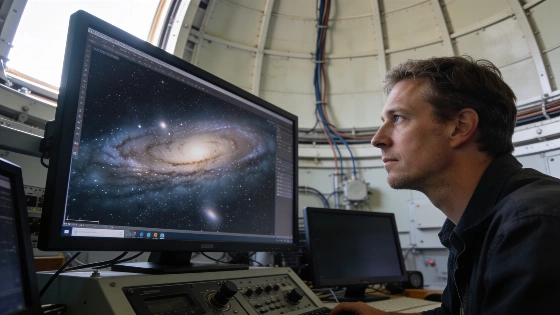
Astronomers using the Hubble Space Telescope have mapped a sharp decline in star formation across the Andromeda galaxy, with evidence pointing to gravitational influence from its smaller neighbor, M32
New analysis of Hubble Space Telescope observations has revealed that the Andromeda galaxy, the Milky Way's nearest large neighbor, has experienced a marked reduction in its star formation rate over the past 40 million years. The findings suggest that this slowdown is not uniform across Andromeda's disk, and may be linked to gravitational interactions with the nearby compact galaxy M32.
Mapping Andromeda's Recent History
Andromeda (M31), located about 2.5 million light-years from Earth, is close enough for Hubble to resolve individual stars in its disk. Over the past decade, two major Hubble surveys have cataloged roughly 200 million stars across two-thirds of Andromeda's visible disk, focusing on those brighter than the Sun. By dividing the galaxy into a grid of 300-light-year squares and analyzing the color and brightness of stars in each region, researchers reconstructed the timeline of star formation across the galaxy.
The data show that about 500 million years ago, Andromeda was converting gas and dust into new stars at a rate comparable to the Sun's mass per year. This rate gradually declined, reaching about half a solar mass per year 40 million years ago, before dropping sharply to just one-fifth of a solar mass per year today. The most pronounced slowdown is observed on the side of Andromeda closest to M32, a region where the star formation rate began to fall more steeply around 60 million years ago.
Possible Role of M32
M32, a compact elliptical galaxy situated only about 16,000 light-years from Andromeda, has long been suspected of having a disruptive influence on its larger neighbor. Its proximity and unusual structure-resembling the stripped core of a once-larger spiral galaxy-have led astronomers to propose that M32 may be the remnant of a past collision with Andromeda. The spatial correlation between the region of greatest star formation decline and M32's location supports the idea that gravitational interactions or a past encounter could have disturbed Andromeda's gas, suppressing the birth of new stars.
However, the evidence remains circumstantial. While the timing and location of the slowdown are consistent with M32's influence, alternative explanations, such as internal processes or interactions with other satellites, cannot be ruled out. The current data do not establish a direct causal link, but they strengthen the case for further investigation of Andromeda's recent dynamical history.
Hubble's Contribution and Future Prospects
The ability to resolve individual stars in Andromeda has been crucial for reconstructing its star formation history. Hubble's surveys, though limited to the brightest stars, have provided an unprecedented dataset for mapping stellar populations across a large spiral galaxy outside the Milky Way. The upcoming Nancy Grace Roman Space Telescope, scheduled for launch in late 2026, is expected to extend this work by imaging even fainter stars and a larger fraction of Andromeda's disk, potentially clarifying the role of satellite interactions in shaping galactic evolution.
These findings add to a growing body of research on how galaxy interactions can influence star formation. For example, studies of other nearby galaxies, such as those discussed in recent reports on supernovae in neighboring systems, highlight the complex interplay between collisions, gas dynamics, and stellar evolution in the local universe.
Understanding the mechanisms that regulate star formation in galaxies like Andromeda is central to unraveling the broader history of cosmic structure. As new telescopes expand the reach and sensitivity of stellar surveys, astronomers expect to refine models of how galaxies grow, interact, and eventually exhaust their star-forming material.
Reconstructing the star formation history of a galaxy relies on analyzing the color and brightness of its stellar populations. Young, massive stars tend to appear blue and luminous, while older, lower-mass stars are redder and fainter. By mapping the distribution of these stars across different regions, astronomers can infer when and where bursts of star formation occurred. This method, known as color-magnitude diagram analysis, is especially powerful when individual stars can be resolved, as in the case of Andromeda with Hubble. However, the approach is limited by the telescope's sensitivity and the effects of dust, crowding, and distance, which can obscure or bias the sample. Future instruments with greater sensitivity and resolution will help overcome these challenges, enabling more precise reconstructions of galactic histories.