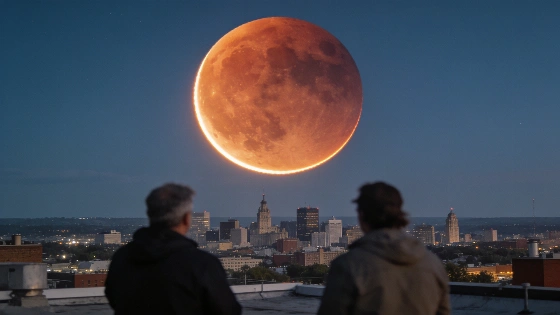
A rare deep partial lunar eclipse will occur on August 28, 2026, with up to 96% of the Moon passing through Earth's umbra. The event will be visible across the Americas, Europe, and Africa, offering a striking copper-red lunar display.
On the night of August 27-28, 2026, observers across much of the Americas, Europe, and Africa will have the opportunity to witness a deep partial lunar eclipse, the most significant of its kind until the end of 2028. During this event, Earth's central shadow will obscure nearly the entire lunar disk, producing a dramatic visual effect often compared to a 'blood moon.' The eclipse will be visible without any special equipment, provided skies are clear and the Moon is above the horizon.
Where and When to Observe
The eclipse will be observable from a wide geographic area, including North and South America, Europe, Africa, and parts of western Asia. The Americas are particularly well positioned, with many locations seeing the Moon already deep in Earth's shadow as it rises. In eastern North America, the Moon will appear coppery-red near the horizon during the peak of the eclipse. Across Europe and Africa, the event will unfold before dawn, with the Moon setting shortly after maximum eclipse in western regions. Visibility decreases further east, with only partial phases observable before moonset in western Asia, and little to no visibility in eastern Asia.
Maximum eclipse is expected to occur in the early hours of August 28, when up to 96% of the Moon's surface will be immersed in Earth's umbra. This deep coverage is rare for a partial eclipse and will create a striking visual effect similar to a total lunar eclipse, with only a thin arc of the lunar surface remaining brightly illuminated.
What to Expect During the Eclipse
As the Moon passes through Earth's umbra, most of its surface will take on a deep reddish or copper hue. This coloration results from sunlight refracted and filtered through Earth's atmosphere, which scatters shorter wavelengths and allows longer red wavelengths to reach the lunar surface. The remaining sliver of the Moon outside the umbra will appear much brighter, creating a sharp contrast and enhancing the visual impact of the event.
Unlike solar eclipses, lunar eclipses are safe to observe with the naked eye. No protective filters or optical aids are required, though binoculars or small telescopes can enhance the view. The phenomenon is accessible to anyone with an unobstructed view of the sky and favorable weather conditions.
Scientific and Observational Context
Lunar eclipses occur when the Sun, Earth, and Moon align so that Earth's shadow falls on the lunar surface. The depth and duration of each eclipse depend on the precise geometry of this alignment. The August 2026 event stands out for its exceptionally deep partial phase, with the Moon nearly fully immersed in the umbra but not quite reaching totality. Such deep partial eclipses are uncommon and provide an opportunity to study atmospheric effects on the color and brightness of the eclipsed Moon.
For those interested in lunar and planetary observation, this eclipse offers a chance to compare the visual appearance of a deep partial eclipse with that of a total lunar eclipse. The event also serves as a reminder of the regularity and predictability of celestial mechanics, which allow astronomers to forecast eclipses with high precision. For additional context on lunar and planetary imaging, readers may find it useful to review how spacecraft such as NASA's ESCAPADE have captured both Earth and the Moon in different wavelengths, as discussed in this recent report.
Preparing for the Event
To observe the eclipse, check local moonrise and moonset times and ensure you have a clear view of the horizon in the relevant direction. Urban light pollution has little effect on lunar eclipses, but clouds can obscure the view. For those unable to observe the event directly, several organizations and astronomy outlets are expected to provide live coverage and imaging online. The next comparable lunar eclipse will not occur until December 2028, making this a notable opportunity for both amateur and professional observers.
Photographers aiming to capture the event should use a tripod and experiment with exposure settings to balance the bright and dark regions of the Moon. Observing the changing color and brightness across the lunar disk can also provide insight into the composition and clarity of Earth's atmosphere at the time of the eclipse.
Lunar eclipses offer a direct demonstration of Earth's shadow and the interplay between sunlight and the atmosphere. When the Moon enters Earth's umbra, the only light reaching its surface has been refracted through the planet's atmosphere, which filters out most blue and green wavelengths. This process gives the eclipsed Moon its characteristic red or copper color. The precise shade and brightness depend on atmospheric conditions, including dust, clouds, and volcanic aerosols, making each eclipse unique and scientifically informative.