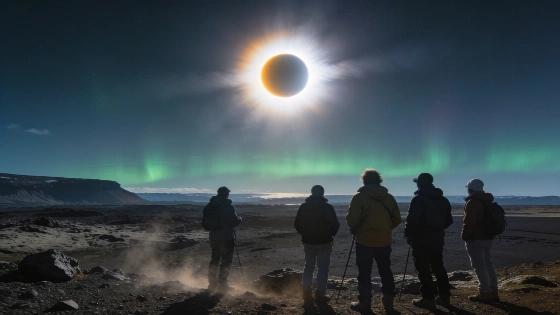
Astronomers assess whether auroras could be visible during the total solar eclipse on August 12, 2026, as the path of totality crosses Greenland, Iceland, and northern Spain, and explain the physical limits on simultaneous observation
On August 12, 2026, a total solar eclipse will sweep across parts of Greenland, Iceland, and northern Spain, offering observers a rare opportunity to witness the Moon fully obscure the Sun. As the sky dims to twilight during totality, some eclipse chasers are asking whether the northern lights-auroras-could also become visible at the same time. The answer, astronomers say, is that while it is physically possible, the odds are extremely low under typical conditions.
Twilight Conditions and Auroral Visibility
During a total solar eclipse, the Sun's disk is completely blocked by the Moon, revealing the faint solar corona and plunging the landscape into a brief period of deep twilight. However, this darkness is not equivalent to true night. The sky brightness during totality is comparable to civil twilight, when the Sun is just below the horizon. In the auroral zone-regions near the magnetic poles where auroras are most common-this level of darkness is usually insufficient for faint auroral displays to become visible to the naked eye.
Experienced aurora chasers have occasionally photographed bright auroras during twilight, but these events require unusually intense geomagnetic activity. The solar corona, visible during totality, is itself bright enough to outshine most auroral features, especially those near the Sun's position in the sky. Only the brightest auroras, and only those far from the Sun's glare, would have any chance of being seen during the eclipse.
Geomagnetic Storms and Physical Limits
The likelihood of seeing auroras during the 2026 eclipse depends on the level of geomagnetic activity at the time. Auroras are produced when charged particles from the Sun interact with Earth's magnetic field, typically following solar eruptions such as coronal mass ejections (CMEs). For auroras to be visible in daylight or twilight, a severe geomagnetic storm-classified as G4 or G5 on the NOAA scale-would need to coincide with the eclipse. Such storms are rare and unpredictable.
Even during strong geomagnetic storms, the dayside auroral oval-the region where auroras are most likely to occur during local daytime-does not expand as dramatically as the nightside oval. Since totality in Greenland and Iceland will occur in the afternoon, observers will be beneath the dayside oval, where auroral displays are typically weaker and less frequent. In northern Spain, the chance is even lower, as the auroral oval would need to expand far southward, requiring a geomagnetic disturbance of exceptional magnitude.
Timing, Geography, and Observational Challenges
Historical attempts to observe auroras during total solar eclipses have generally failed due to insufficient darkness. For example, during the 2015 total solar eclipse over Svalbard, observers reported that the sky remained too bright to see even the brightest stars or planets, let alone auroras. Snow-covered landscapes and atmospheric scattering can further brighten the sky, reducing contrast and making faint phenomena harder to detect.
The timing of the 2026 eclipse places totality in the afternoon for Greenland and Iceland, and early evening for northern Spain. At these times, the Sun is still relatively high, and the auroral oval is not optimally positioned for strong displays at these latitudes. According to auroral physicists, only an extreme geomagnetic event-one that pushes the Kp index to 9-would make auroras visible as far south as Spain during the eclipse, and even then, the overlap with totality would be brief and uncertain.
Coinciding Astronomical Events
While the probability of seeing both a total solar eclipse and auroras simultaneously is low, the date of August 12, 2026, is notable for another reason: it coincides with the peak of the Perseid meteor shower. This rare alignment means that, under the right conditions, observers in Iceland or Greenland could potentially witness three major astronomical phenomena-an eclipse, auroras, and meteors-within a single night. However, the occurrence of all three at once would require an unusual combination of solar activity and clear skies.
For those interested in the path and timing of the 2026 eclipse, astronomers have explained how map projections can distort the apparent direction of the Moon's shadow as it crosses the Arctic. For a detailed discussion of this effect, see the analysis of how map projections affect the eclipse path.
Even if auroras do not appear during totality, the eclipse itself remains a rare and scientifically valuable event, offering a unique opportunity to study the solar corona and atmospheric effects under controlled conditions.
Understanding the interplay between solar eclipses and auroral displays requires knowledge of both atmospheric optics and space weather. Auroras are caused by energetic particles from the solar wind colliding with atoms in Earth's upper atmosphere, producing characteristic green and red emissions. The visibility of auroras depends on sky darkness, geomagnetic activity, and the observer's location relative to the auroral oval. During a total solar eclipse, the brief twilight is usually not dark enough for faint auroras to be seen, and only the most intense geomagnetic storms can produce visible displays in daylight. The rarity of such storms, combined with the timing and geography of the 2026 eclipse, makes the simultaneous observation of both phenomena highly unlikely, but not physically impossible.