
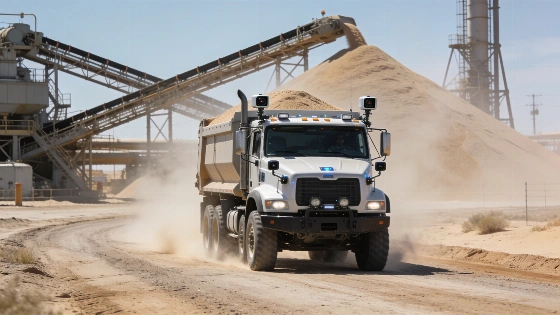
Atlas Energy Solutions plans to increase its AI-enabled driverless truck fleet in the US Permian Basin, aiming for 100 vehicles by mid-2027, to automate sand delivery for hydraulic fracturing across private oilfield routes
Atlas Energy Solutions has announced plans to expand its fleet of driverless trucks operating in the US Permian Basin, targeting an increase from 28 to 100 vehicles by mid-2027. The company is collaborating with Kodiak AI to retrofit heavy trucks with a suite of sensors, cameras, and control systems designed to enable automated driving for the transport of proppant sand, a critical material used in hydraulic fracturing. The deployment is focused on private oilfield logistics networks, where the operational environment is more controlled than public highways.
The trucks are intended to move sand from Atlas's load-out points along the 68-kilometer Dune Express conveyor system, which supplies proppant to oil and gas drilling sites. Proppant sand is pumped underground during hydraulic fracturing to keep fractures open, allowing hydrocarbons to flow. The logistics challenge involves thousands of repetitive truck journeys on predictable, often remote routes. By automating these deliveries, Atlas aims to improve responsiveness to customer orders and reduce operational inefficiencies.
Deployment and Performance
According to Atlas, the current driverless fleet has operated from a single load-out point at a time, but the planned expansion will enable simultaneous operations from two locations-one in Texas and one in New Mexico. The company reports that its autonomous trucks have completed approximately 7,000 deliveries, transporting around 450,000 metric tons of sand over 23,500 hours of driverless operation. These figures reflect activity on private roads within oilfield infrastructure, where traffic and environmental variables are more predictable than on public highways.
It is important to note that, so far, Atlas's driverless trucks have not operated on public roads. The company states that it intends to begin public-road operations by early 2027, pending regulatory and operational approval. Operating on public highways introduces additional complexity, including variable traffic, unpredictable human drivers, and stricter safety requirements. The transition from private to public roads will require further technical validation and regulatory oversight.
Technical and Regulatory Considerations
The driverless system developed by Kodiak AI relies on a combination of physical sensors, onboard computing, and machine-learning algorithms to perceive the environment and control vehicle movement. While the company describes the system as "autonomous," the current deployments are limited to private, controlled environments where the risk profile is lower and the operational design domain is tightly constrained. Human intervention remains possible in the event of system failure or unexpected obstacles, and the company has not disclosed the frequency of such interventions.
Atlas's expansion plan is presented as a step toward transforming oilfield logistics through automation, but the evidence to date is limited to company-reported figures and controlled deployments. There is no independent verification of safety performance, intervention rates, or cost savings. Regulatory approval for public-road operation will require demonstration of safety and reliability under more challenging conditions, and it remains to be seen how the system will perform outside the controlled oilfield environment.
Numerical Context
Based on company data, Atlas's driverless trucks have carried out approximately 7,000 sand deliveries, moving a total of 450,000 metric tons over 23,500 hours of automated operation. The current fleet consists of 28 vehicles, with a target of 100 by mid-2027. The Dune Express conveyor system spans 68 kilometers, with load-out points in both Texas and New Mexico. These operations are confined to private oilfield roads, and no public-road deployments have been reported as of 2026.
Automating repetitive logistics tasks in industrial settings is a longstanding goal of robotics and AI research. In this context, the operational design domain-the set of conditions under which an autonomous system is intended to function-plays a critical role in determining both safety and reliability. Private oilfield roads offer a more predictable environment than public highways, reducing the number of unexpected variables the system must handle. However, expanding to public roads introduces new challenges, including dynamic traffic, regulatory scrutiny, and the need for robust fail-safe mechanisms. The distinction between automation in controlled domains and true operational autonomy in open environments remains central to evaluating the progress and risks of driverless vehicle deployments.