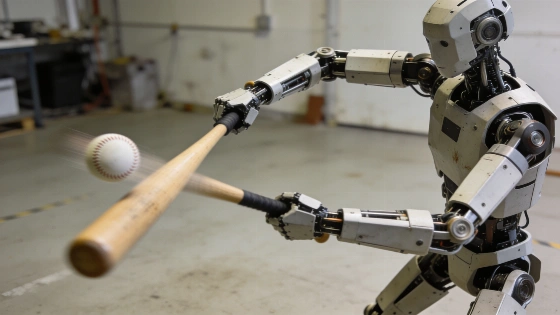
AthenaZero threw balls, caught them and hit them with a bat in research evaluations. The three tasks test how a robot's mass and mechanical design affect fast physical interactions
AthenaZero has thrown, caught and hit balls with a bat, demonstrating how a robot's physical design can support fast contact with moving objects. Developed by the Robotics and AI Institute (RAI), the stationary, two-armed research system was evaluated on three baseball-inspired tasks described in a Science Robotics study published on September 16, 2026.
The experiment addresses a problem that software alone may not solve: how a robot's mass, inertia and ability to yield at its joints shape its response when objects move or make contact. The researchers investigated whether designing those mechanical properties differently could support forceful movements while also allowing controlled physical interaction.
AthenaZero is a research platform for dynamic manipulation, not a mobile, general-purpose humanoid. Its fixed body has one degree of freedom, while each arm has seven degrees of freedom and each underactuated hand has six. The baseball exercises test dynamic movement and contact; they are not demonstrations of routine work in a production environment.
The system's central torso carries two arms fitted with hands. Its rigid arm segments are connected by compliant joints that can yield to external forces in a controlled way. The team also designed the system to have low effective inertia: less resistance to changes in motion can let an arm accelerate or decelerate more readily.
AthenaZero uses quasi-direct-drive actuators, which connect motors to joints through lower gear reductions than those used in many conventional industrial robots. The reduction ratio is about 5:1 for most joints. Minimizing transmission mechanisms at the joints lowers reflected inertia-the load that the motors must overcome during fast movements. The reported effective mass at the arm's end is about 3.97 kilograms, roughly an order of magnitude below that of traditional manipulators.
That design differs from the stiffness prioritized by many industrial robots, which supports precise and repeatable positioning in tasks such as moving heavy objects or placing components. When objects move quickly or contact needs to be managed gently, a rigid response can be a limitation. AthenaZero combines low inertia with compliant joints to explore a mechanical approach that can accommodate both delicate and forceful interactions.
The approach puts hardware at the center of the manipulation problem. A robot's control software still matters, but its instructions must act through real motors, joints and masses. The team's design tests whether changing those physical properties can make dynamic movements easier to control, rather than relying only on increasingly elaborate software.
Baseball tasks expose different parts of that challenge. Throwing requires coordinated movement to transfer force to a ball. Catching requires a response to an approaching object and management of the forces at contact. Hitting with a bat requires both arms to position and swing it with suitable timing.
In the reported evaluations, AthenaZero threw a ball at more than 30 meters per second, or 108 kilometers per hour. Catching and batting tests involved balls moving faster than 14 meters per second over a distance of about 7.3 meters. In the batting test, the robot made contact with the ball in 27 of 33 attempts, approximately 82 percent. These were controlled laboratory trials, not a baseball game or professional batting record.
The research team included roboticist Andrew S. Morgan. The demonstrations describe a mechanical design and task performance; they do not establish that the platform can operate independently in everyday settings. AthenaZero remains fixed in place and has no legs, feet, pelvis or head. The tests do not demonstrate mobility or establish suitability for serial production or regular industrial operations.
The distinction matters because a successful demonstration shows a machine performing a task under particular conditions; it does not by itself establish reliable operation across varied environments. The reported results focus on whole-arm dynamics and coordinated physical interaction. A separate approach to robotic manipulation appears in Atlas hand research, while AthenaZero's baseball tests examine how low-inertia mechanics and compliant joints support fast movement and contact.
Inertia describes how strongly an object resists a change in its motion. For a robot arm, effective inertia depends on the arm's physical construction and how its moving parts behave. Lower effective inertia can make motion changes easier, but it does not by itself guarantee accurate timing, safe contact or successful manipulation. Those outcomes also depend on control, sensing and the conditions in which the robot is tested.