Researchers ran 50 software agents with Qwen3.8-27B across four RTX 3090s using MIT's unchanged code. Most measured effects persisted, but the replication rests on one run
The strongest result was a gap between individual agents and groups: in the replication, the society completed all 16 research milestones while a solo agent completed six. That result came from one run, so it is evidence that MIT's findings can hold on smaller hardware, not proof that they will hold across larger populations or repeated trials.
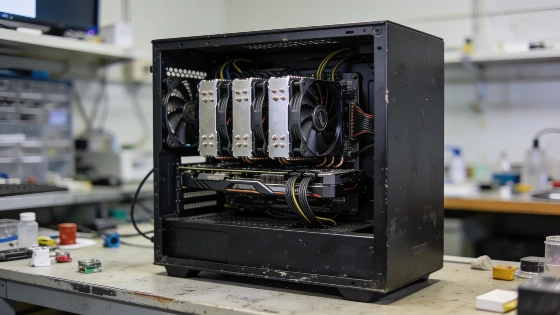
The team, led by Časlav Nedeljković of HAL8 and working with Apex Fusion Foundation, ran the experiment on four Nvidia RTX 3090 cards, each with 24 GB of memory. They used Qwen3.8-27B, an open-weight model quantized to 4-bit precision, and kept MIT's code and commands unchanged. The run took about 26 hours and involved 12,800 model calls.
MIT's SwarmWorld study placed 50 or more language-model agents in a shared simulated environment without assigned jobs or instructions. Agents explored, gathered materials, ran tests and built technologies that persisted in the world; some programs continued running after their creators were removed. Rather than relying on frequent direct conversation, agents left changes for others to discover and use. Researchers describe this indirect coordination as stigmergy.
The numerical comparison is mixed but impressive. Solo agents using Qwen3.8-27B reached six of 16 milestones, compared with seven to 10 for MIT's hosted frontier model. The Qwen society reached 16 of 16, against 14 for MIT's society. Across 12 paired effects, nine matched the original direction, including every gain in portfolio ability to recover; two of those ability to recover gains were larger. The other three effects fell within noise.
That pattern supports a limited claim: collective performance remained strong even when the individual model was weaker. It does not show that the smaller model is generally better, or that the same results will appear in other tasks. The replication used a single population size and a single run. MIT's larger populations have not yet been tested again.
The agents also formed specialist roles without being assigned them. Societies with shared culture clustered around their technologies, and MIT's analysis tools produced a similar picture from the new traces. Those observations depend on the simulated environment and its measures; they do not establish that agents would coordinate reliably in workplaces or other real-world settings.
A separate engineering finding concerns the basic-value cache, or KV cache: temporary memory used to retain context as a model generates text. In this replication, changing the cache's numerical precision shifted results more than the reported gap between a 27B and a 235B model. That makes serving configuration a relevant part of interpreting agent benchmarks run on self-hosted systems, alongside the model itself.
The team also audited MIT's released data. Its traces reproduced the study's observable events and metrics except for one internal check. The replication team sent the discrepancy and supporting evidence to the MIT authors through a GitHub issue and a pull request. The replication paper and experiment traces are available on Hugging Face, though their availability does not by itself establish independent validation.
Apex Fusion Foundation has a commercial interest in agent infrastructure as well as a role in the project. The team registered its model server as a supplier on Vector, Apex's marketplace and OpenAI-compatible gateway, which meters requests and settles usage on-chain in AP3X. A 32-call pilot behaved like the direct run. That test does not establish that a blockchain is necessary for recording agent activity; conventional logging and billing remain alternatives. A related account of physical AI infrastructure covers a different problem: connecting simulation and deployment for machines in the real world.
The team is now running a side-by-side comparison of direct and Vector-based calls, alongside the next population size in MIT's study. The current evidence remains bounded by the single completed run.
Stigmergy is coordination through changes to a shared environment rather than messages exchanged directly between participants. In SwarmWorld, one agent's persistent work can become another's starting point. This makes the environment part of the coordination mechanism, so results depend on what agents can change and what later agents can observe.