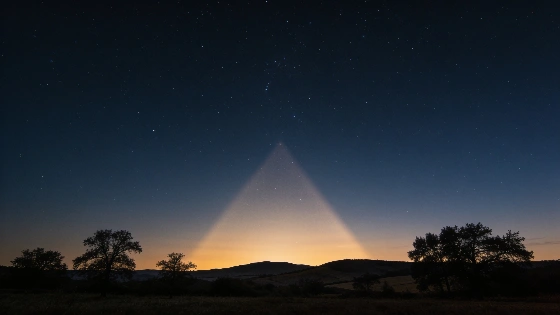
A faint pyramid of zodiacal light will become visible in the eastern sky before dawn this September, offering a rare opportunity for observers to witness sunlight scattered by interplanetary dust using only the naked eye under dark conditions
Before sunrise in early September, a subtle but scientifically revealing glow will rise above the eastern horizon for those willing to seek out darkness and patience. This phenomenon, known as zodiacal light, is not a trick of the atmosphere or a sign of approaching dawn, but a direct result of sunlight reflecting off dust particles scattered throughout the inner solar system.
Origin of the Zodiacal Light
The zodiacal light is produced by sunlight scattering off countless microscopic dust grains that orbit the Sun in the plane of the solar system. These grains, remnants of comets and asteroids, form a diffuse cloud concentrated along the ecliptic-the path traced by the Sun, Moon, and planets across the sky. When the geometry is favorable, as it is in early September for the Northern Hemisphere, this dust cloud becomes visible as a faint, wedge-shaped glow extending upward from the horizon before dawn.
Unlike the familiar glow of morning twilight, the zodiacal light appears as a distinct cone, often mistaken for the first light of day by those unfamiliar with its origin. Its visibility depends on the angle of the ecliptic relative to the horizon, which is steepest in the pre-dawn hours of early autumn, allowing the light to stand clear of atmospheric interference.
Observing Conditions and Visibility
To detect the zodiacal light, observers must escape city lights and artificial illumination. The best viewing window occurs around 4:00 a.m. Eastern Daylight Time, when the sky is darkest and the ecliptic rises sharply in the east. Allowing at least 20 minutes for eyes to adapt to the darkness is essential, as even brief exposure to phone screens or flashlights can erase the faint glow from view.
Under optimal conditions, the base of the light cone appears near the constellation Cancer, stretching upward through Gemini and toward Taurus. The phenomenon is subtle-its surface brightness is far lower than the Milky Way-so clear, dry air and minimal moonlight are critical. The zodiacal light is most prominent for several weeks each year, with early September offering one of the most favorable alignments for northern observers.
Capturing the Phenomenon
Photographing the zodiacal light requires techniques similar to those used for imaging the Milky Way. A fast, wide-angle lens-such as a 14 mm lens at f/2.8-paired with a high ISO setting (1600 to 3200) and a 15- to 20-second exposure on a fixed tripod can reveal the faint diagonal glow. The resulting image will show the light cone rising through the zodiacal constellations, providing a visual record of interplanetary dust illuminated by the Sun.
For those tracking other rare celestial events, the challenge of observing faint phenomena is not new. As reported earlier, even bright planets can vanish from view under the right conditions, underscoring the importance of preparation and timing in astronomical observation.
Physical and Scientific Significance
The zodiacal light is more than a visual curiosity. Its brightness and shape provide direct evidence of the distribution and composition of dust in the inner solar system. By studying its intensity and seasonal variation, astronomers can infer the sources and sinks of interplanetary dust, test models of dust grain dynamics, and refine estimates of the total mass of material orbiting between the planets. The phenomenon also serves as a foreground for infrared and optical observations, requiring careful subtraction in studies of the cosmic background light.
Despite its faintness, the zodiacal light remains a persistent reminder that the solar system is not empty space, but a dynamic environment shaped by ongoing collisions, cometary activity, and the slow accumulation of debris over billions of years. Its annual return offers both a challenge to observers and a window into the processes that continue to shape planetary systems.
Understanding the zodiacal light requires familiarity with the concept of the ecliptic and the scattering of sunlight by small particles. The ecliptic is the apparent path traced by the Sun across the sky, marking the plane of Earth's orbit and, by extension, the orbits of most solar system bodies. Dust grains in this plane scatter sunlight most efficiently at low angles, producing the characteristic wedge of light. The phenomenon is strongest when the ecliptic rises steeply from the horizon, as in early autumn mornings for northern observers. Recognizing the zodiacal light depends on both dark-sky conditions and an awareness of its subtle distinction from ordinary twilight.