
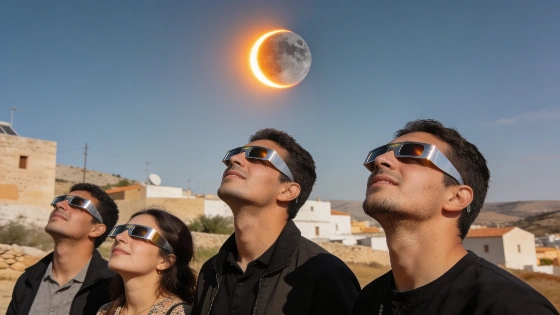
Astronomers are preparing for two rare solar eclipses in 2027, including a 'ring of fire' annular eclipse in February and an unusually long total solar eclipse in August, both visible across parts of South America, Africa, and Europe
Millions of observers across Greenland, Iceland, and Spain recently witnessed a total solar eclipse, while a partial eclipse was visible throughout much of Europe and northwest Africa. For those eager to experience more, 2027 will bring two significant solar eclipses, each offering distinct observational opportunities for both professional astronomers and the public.
Annular Eclipse in February
On February 6, 2027, an annular solar eclipse-commonly known as a 'ring of fire'-will be visible along a narrow path crossing parts of Chile, Argentina, and the coastal regions of West Africa. During an annular eclipse, the Moon passes directly in front of the Sun but appears slightly smaller than the solar disk, leaving a bright ring of sunlight visible around the lunar silhouette. This occurs because the Moon is near apogee, its farthest point from Earth, and cannot fully obscure the Sun's apparent diameter.
Observers within the path of annularity will see the full ring effect, while a partial eclipse will be visible across broader areas of South America and West Africa. The event will be observable with proper eye protection, and astronomers recommend using certified solar filters or indirect viewing methods to prevent eye damage. The geometry of this eclipse provides a valuable opportunity to study the Sun's outer atmosphere and the effects of lunar distance on eclipse appearance.
August's Total Solar Eclipse
Six months later, on August 2, 2027, a total solar eclipse will sweep across southern Europe, North Africa, and the Middle East. This event is notable for its exceptional duration: at the point of greatest eclipse, totality will last approximately 6 minutes and 23 seconds, making it one of the longest total solar eclipses of the 21st century. For comparison, most total solar eclipses last between two and three minutes.
The path of totality will cross densely populated regions, including parts of Spain, Egypt, and Saudi Arabia, offering millions the chance to observe the Sun's corona-a region of plasma extending millions of kilometers into space-under optimal conditions. Favorable weather patterns in North Africa during August may further increase the likelihood of clear skies for eclipse viewing. For those planning to travel, expert advice on site selection and logistics can help maximize the scientific and visual experience.
Scientific and Observational Value
Both eclipses present unique opportunities for scientific study. Annular eclipses allow researchers to examine the Sun's photosphere and chromosphere, while total eclipses enable direct observation of the corona, which is otherwise obscured by the Sun's brightness. These events also provide a natural laboratory for testing solar models, calibrating instruments, and engaging the public in observational science.
Interest in solar eclipses has grown in recent years, with the 2026 total solar eclipse across Europe and the Arctic drawing significant attention. For a detailed breakdown of eclipse stages and observational phenomena during that event, see this analysis of the five stages of the 2026 total solar eclipse. The 2027 eclipses are expected to build on this momentum, with coordinated campaigns planned by professional and amateur astronomers alike.
Planning and Limitations
While the paths of annularity and totality are precisely calculated using celestial mechanics, local weather, atmospheric conditions, and geographic accessibility will influence the quality of observations. Eclipse chasers are advised to monitor meteorological forecasts and prepare for logistical challenges, especially in remote or high-demand locations. The rarity of such long-duration totality makes the August 2027 event particularly attractive for scientific teams aiming to collect high-resolution data on coronal dynamics and solar wind structures.
It is important to note that safe solar viewing practices are essential for all phases of both eclipses. Only during the brief period of totality is it safe to observe the Sun without protection; at all other times, certified solar filters must be used. The next comparable opportunity for extended totality will not occur for several decades, underscoring the significance of the 2027 eclipse season for solar research and public engagement.
Solar eclipses occur when the Moon passes between Earth and the Sun, casting a shadow on Earth's surface. The type of eclipse-total, annular, or partial-depends on the apparent sizes and alignment of the Sun and Moon as seen from specific locations. Total eclipses reveal the Sun's corona, while annular eclipses display a ring of sunlight. Accurate prediction of eclipse paths relies on precise measurements of the Moon's orbit, Earth's rotation, and the geometry of the Sun-Earth-Moon system. These rare alignments provide critical opportunities to study solar and atmospheric phenomena that are otherwise inaccessible.