Astronomers have modeled why repeated flares from stars grazing supermassive black holes fade over time, revealing that a star's rotation and binary history play a key role in the observed dimming
When a star passes close to a supermassive black hole, the encounter can produce a dramatic flare as the black hole strips away stellar material. While some stars are completely torn apart in a single event, others survive multiple close approaches, generating a series of flares that fade with each episode. New research published in The Astrophysical Journal investigates why these recurring flares, known as repeating partial tidal disruption events (rpTDEs), become progressively dimmer, and finds that the star's spin and binary origin are central to the process.
Partial Disruption and Fading Flares
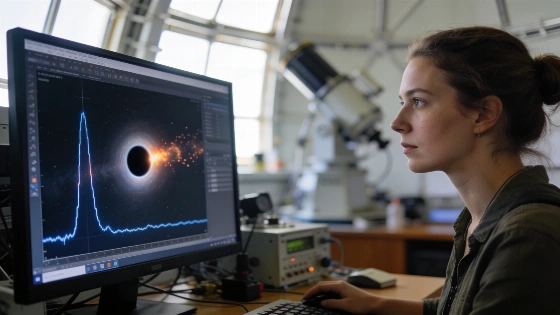
Supermassive black holes, which reside at the centers of most galaxies, can disrupt stars that venture too close through intense tidal forces. In a full tidal disruption event (TDE), a star is stretched and destroyed, producing a luminous flare as its material accretes onto the black hole. However, in rpTDEs, the star survives the initial encounter, losing only part of its mass and returning for subsequent orbits. Observations of these events have shown that the resulting flares often decrease in brightness over time, a pattern that has puzzled astronomers.
Researchers at Syracuse University modeled the physical processes involved in rpTDEs, focusing on how the star's internal structure and rotation affect mass loss. Their analysis indicates that the amount of material stripped during each passage depends not only on the star's mass and composition, but also on how rapidly it spins. This insight helps explain why some rpTDEs show pronounced dimming while others do not.
The Role of Stellar Spin
The team's simulations reveal that a star's spin rate before its first encounter with a black hole is a critical factor. If the star is already spinning rapidly, the torque exerted by the black hole during each passage does little to increase its rotation. As a result, the time between successive encounters remains roughly constant, and the amount of material lost in each episode steadily declines, leading to dimmer flares.
In contrast, a slowly rotating star can be spun up by the black hole's tidal forces, shortening the interval between passages and maintaining a higher rate of mass loss. This mechanism can keep the flares relatively bright for longer. The researchers found that this difference in spin evolution accounts for the observed diversity in rpTDE light curves, particularly the pronounced dimming seen in some cases.
Binary Origins and Black Hole Capture
To understand why some stars approach supermassive black holes with high spin rates, the study considered the dynamics of binary star systems. Most stars in galactic centers are thought to exist in binaries. When such a pair passes near a black hole, gravitational interactions can eject one star while capturing the other-a process known as Hills capture. If the binary was tightly bound, the captured star may be left spinning rapidly and on a close orbit around the black hole, setting the stage for rpTDEs with dimming flares.
This scenario is consistent with the orbits and spin rates inferred for stars observed near the Milky Way's central black hole, Sagittarius A*. The findings suggest that the interplay between binary disruption and stellar spin is a key driver of the diversity seen in rpTDEs across different galaxies.
Observational Evidence and Model Limits
To date, astronomers have identified ten rpTDE candidates, with four showing clear evidence of dimming flares. The new model matches the observed light curves for these events, supporting the idea that stellar spin and binary history are decisive factors. However, the sample remains small, and uncertainties persist regarding the detailed structure of stars undergoing partial disruption and the precise dynamics of their orbits.
The research relies on numerical simulations and analytic models rather than direct observation of the stars' spins or binary origins. Future observations, particularly with high-cadence surveys and improved modeling of stellar interiors, may help test these predictions and refine our understanding of how supermassive black holes interact with their stellar environments.
Understanding rpTDEs not only sheds light on the fate of stars near black holes, but also provides a window into the population of stars and binaries in galactic centers, and the mechanisms by which black holes grow over cosmic time.
In the context of black hole astrophysics, a tidal disruption event (TDE) occurs when a star passes close enough to a black hole that tidal forces exceed the star's self-gravity, pulling it apart. In a partial TDE, only part of the star is stripped, and the remnant can survive multiple passages. The resulting flares are powered by the accretion of stripped material onto the black hole, producing electromagnetic emission across a range of wavelengths. The brightness and evolution of these flares depend on the amount of mass lost, the star's structure, and the orbital dynamics, making them valuable probes of both stellar and black hole physics.