Realbotix says Echo combines silicone-covered humanoid hardware with access to ChatGPT and other conversational systems. Its planned 250-unit run is due for delivery in 2027, with software fees added to prices reaching $59,950
Realbotix announced its Echo humanoid robot line on October 26, 2026, with an initial production run of 250 units scheduled for delivery in the second half of 2027. The allocation consists of 225 Echo Tabletop units and 25 Echo Full Body models. The limited batch sets the scale of the announcement: this is a small planned release, not evidence of humanoid robots entering routine use.
Prices start at $11,950 for the tabletop model and reach $59,950 for a full-body version. Customers can reserve a unit with a $199 deposit, but ownership also requires a monthly subscription to the Robot Configuration App. Realbotix lists plans starting at $19.99 per month, with subscription tiers determining access to AI platforms and features.
Those figures buy a physical platform designed for individual interaction. Realbotix positions Echo for personal interaction, education and wellness, and identifies therapy as a possible setting. The product description does not establish that Echo has been tested for therapeutic benefit or that it can provide care.
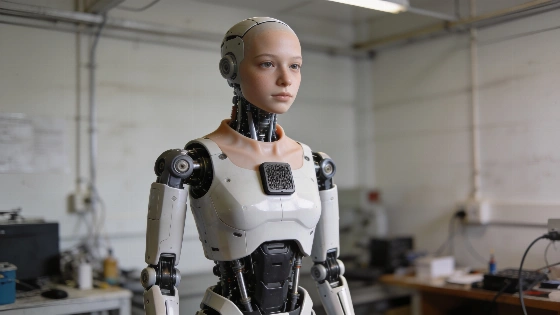
The two configurations differ substantially in size and movement. The Echo Tabletop stands 32 inches (81 centimeters) tall, measures 13 by 13 by 32 inches and weighs about 25 pounds (11 kilograms), with 17 degrees of freedom. Its proprietary silicone-based synthetic skin covers the face and neck. The Full Body model is listed at 72 inches (183 centimeters) for the female configuration and 77 inches (196 centimeters) for the male version; it measures 28 by 28 inches (71 by 71 centimeters) and weighs about 88 pounds (40 kilograms). Its silicone-based synthetic skin covers the face, neck, lower arms and hands. Realbotix lists 39 degrees of freedom for upper-body movement.
That joint count needs careful interpretation. Realbotix describes fluid upper-body motion, while its specifications do not describe a fully articulated human body. A degrees-of-freedom figure counts permitted movement axes; it does not show how smoothly or reliably a robot performs a task. The product specifications describe the platform's physical configuration, not a demonstrated level of autonomy, dexterity or reliability.
Echo's conversation functions connect to ChatGPT and Claude; Gemini is also supported through subscription tiers. Realbotix offers four character options: Aria, Mila, Dave and Amar, each with its own face, voice and personality. The company says the robots can communicate in more than 100 languages and respond in the language used by the person speaking to them. These features describe software access and product behavior, not evidence that the robot understands a user or experiences empathy.
An optional system called Vinci adds on-device computer vision. Realbotix says it supports biometric facial recognition, gaze tracking, emotional-cue detection and spatial awareness. The company says visual data can remain local and describes the feature as a privacy-focused option. Vinci's advertised capabilities are product features; the announcement does not establish recognition or emotion-detection accuracy through independent testing.
Realbotix says conversation histories and saved memories stay on the robot or a paired device. It also says facial-recognition data remains local and is not used for advertising. Cloud services create a separate data path: when Echo uses external AI, speech or avatar services, information needed to provide those functions may go to third-party providers. The company says it receives service-usage logs but cannot directly access conversation content processed by those providers.
The company also plans digital AI twins for 2027. Subscribers are expected to interact with a selected character through a computer, tablet or phone when away from the physical robot. Realbotix says encrypted memories and preferences will carry between digital and physical versions. Those are announced plans; the company has not reported a completed launch or a test of how well information transfers.
Echo is aimed at personal interaction rather than factory work, a different setting from the factory logistics trials reported elsewhere. That distinction matters: a conversational interface and lifelike exterior do not establish industrial capability, nor do they demonstrate dependable social support. Realbotix says it plans to exhibit Echo at CES 2027, before the first deliveries scheduled for the second half of that year.
Degrees of freedom describe how many independent axes of movement a mechanism can make. The count alone does not specify speed, force, range of motion or control quality, and it cannot be treated as a measure of humanlike mobility. Realbotix lists 39 degrees of freedom for upper-body movement on the Echo Full Body.