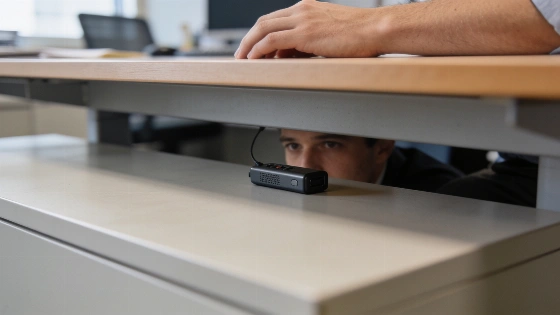
OpenAI says its models helped trace a concealed recording device to an employee later arrested by the FBI. The company has not explained what evidence the models analyzed or how their findings were verified
The FBI arrested an OpenAI employee suspected of planting a concealed recording device in one of the company's offices, OpenAI says. The company says its models helped investigate the device and identify the employee, but has not described the technical process behind that claim. The U.S. Department of Justice identified the employee as Abdulrahman Alfozan, a 35-year-old Saudi national, and said he was arrested on October 9, 2026.
OpenAI says it discovered the device on September 30 and used its models to examine what it was, where it came from, and who may have installed it. According to the Justice Department, the audio-recording device was concealed in toilet paper and plugged into a USB port on the back of a television in a leadership conference room at the company's San Francisco office. The complaint says it may have been installed around September 28 and that its contents were encrypted. OpenAI terminated the employee and referred the case to federal authorities.
The Justice Department announced the arrest on October 13, the day Alfozan made his initial court appearance in the U.S. District Court for the Northern District of California. He is accused of attempting to intercept oral communications using an electronic, mechanical, or other device. The charge remains an allegation, and the case was still under federal investigation.
OpenAI says its models helped determine the device's purpose and origin and identify the suspected installer. The company has not described what evidence the models analyzed or how investigators checked their findings against other evidence. The account does not establish how much the models contributed to the investigation.
A model's output is not, on its own, proof of who placed a device or when. OpenAI has not detailed the technical process behind the models' role. The company's announcement therefore describes their reported assistance in its internal inquiry, while the employee's arrest and the criminal allegation are matters being handled by federal authorities.
The Justice Department's account places the discovery on September 30, about nine days before the arrest, and the initial court appearance four days after the arrest. Public reporting by the Associated Press also describes the device as concealed inside a toilet-paper roll and connected to the television's USB port. The device's manufacturer, recording duration, number of conversations captured, and whether any recordings were retrieved have not been publicly established.
OpenAI reported no indication that the employee improperly accessed or removed model weights, source code, or customer information. That statement concerns those categories of company data; it does not establish whether the device captured conversations or other information in the conference room. FBI Director Kash Patel said the device was allegedly intended to record sensitive discussions related to OpenAI's superintelligence technology.
OpenAI presents the case as an example of using its technology to investigate security threats. The company says its security program covers risks involving employees, cybercriminals, and nation-state actors. In this case, it has not disclosed which models it used or how they contributed to identifying the suspected installer.
The arrest also comes amid other security-related news at the company, though OpenAI has not said the events are connected. On Friday, it said it had dismissed three researchers after an investigation into alleged breaches of policies governing sensitive information. Jasmine Wang, Tomek Korbak, and Mikita Balesni published a letter about their dismissals and concerns that the company's actions could discourage open discussion of safety issues. Earlier this year, a Texas man was charged in connection with an alleged Molotov cocktail attack at CEO Sam Altman's home and an attempt to set fire to OpenAI's headquarters. Those incidents have different reported circumstances.
Model weights are numerical parameters learned during training that shape how a model processes inputs and generates outputs. They are distinct from source code, which contains instructions used to build or run software. OpenAI's statement says there was no indication the employee improperly accessed or removed either asset; it does not explain the models' investigative method or establish what the recording device captured. The Justice Department's announcement identifies the charge and the dates in the federal case.