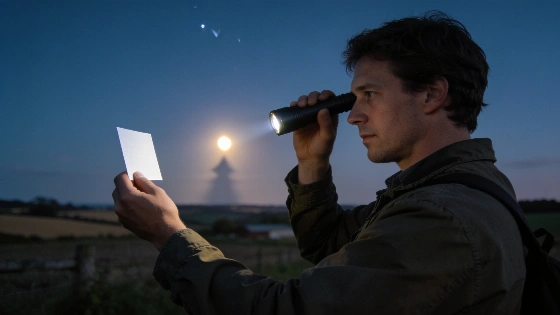
Venus is nearing its peak brightness, offering a rare chance to observe whether the planet can cast a visible shadow. Astronomers explain the conditions and techniques needed to detect this subtle phenomenon.
Venus, often called the evening star, is currently approaching its greatest brilliancy in the night sky. This period offers a unique opportunity to test a longstanding claim in observational astronomy: can Venus, after the Sun and Moon, cast a detectable shadow on Earth? While the effect is subtle and easily overwhelmed by artificial lighting, careful observation under the right conditions can reveal this elusive phenomenon.
Venus at Its Brightest
Venus is now visible low in the western sky after sunset, shining with a magnitude between -4.3 and -4.6 as it nears its greatest eastern elongation. This phase occurs when Venus appears farthest from the Sun in the evening sky, making it especially prominent before twilight fades. Although Venus is currently about 49% illuminated and growing larger in apparent size as it approaches Earth, its maximum brightness does not coincide with its fully lit phase. Instead, the planet appears brightest when its crescent is wide enough and close enough to Earth for its highly reflective clouds to scatter sunlight efficiently toward us.
On August 14-15, Venus sits roughly 46 degrees from the Sun, dominating the twilight sky. Its greatest brilliancy is expected around September 18, when it will reach magnitude -4.6. However, by that date, Venus will be lower on the horizon for observers in mid-northern latitudes, making the shadow-casting experiment more challenging in regions like the UK but still feasible in much of the United States.
Testing the Shadow Claim
The possibility of Venus casting a visible shadow is supported by anecdotal reports and careful experiments, but only under very dark, clear skies. Urban environments, with their pervasive artificial lighting, make such observations nearly impossible. To attempt the observation, astronomers recommend finding a location far from city lights and waiting until the end of twilight. Facing Venus, place a white card or sheet perpendicular to the planet's position and use an object-such as a stick or hand-to cast a shadow onto the surface. The shadow, if visible, will be extremely faint and may be easier to record with a camera using a high ISO, wide aperture, and exposures up to 30 seconds. Testing the setup while Venus is still high above the horizon can improve the chances of success.
If conditions do not allow for shadow detection, observers can instead try to photograph Venus's light reflecting off a body of water. Using the same long-exposure technique, a pond, lake, or ocean can reveal the planet's bright reflection, providing another way to document Venus's exceptional luminosity.
Celestial Context and Observing Tips
This week is favorable for observing faint astronomical phenomena, as the new moon on August 12 ensures dark skies. On August 15 and 16, a waxing crescent Moon-12% and 19% illuminated, respectively-will appear near Venus in the evening sky. Observers may also notice 'earthshine,' the faint glow on the Moon's darkened limb caused by sunlight reflected from Earth, which can be captured with long-exposure photography. Early in the week, the Moon sets early enough to leave much of the night available for deep-sky observation.
While the Perseid meteor shower has passed its peak, some meteors remain visible after midnight, especially with the Moon out of the way. The Milky Way is also prominent, stretching through the Summer Triangle and toward the constellations Scorpius and Sagittarius. For those interested in planetary alignments, a recent event saw the crescent Moon pass close to Mars in Taurus, as detailed in our coverage of the August 9 pre-dawn conjunction.
Scorpius and the Summer Sky
Scorpius stands out as one of the most recognizable constellations visible from mid-northern latitudes, though it remains low in the southern sky. Its brightest star, Antares, marks the heart of the scorpion and can be seen above Venus as darkness falls. The constellation's distinctive hooked shape makes it a useful guide for locating the Milky Way as it meets the horizon. Observing Scorpius is best done earlier in the evening before it sets, and even in areas with moderate light pollution, its pattern remains identifiable.
For those seeking to maximize their view of faint objects, the period between last-quarter Moon and new Moon is ideal for visiting dark-sky sites. With Venus at its brightest and the Moon offering minimal interference, this week provides a rare window for both planetary and deep-sky observation.
Detecting a shadow cast by Venus is a demanding observational challenge that highlights the limits of human vision and the sensitivity of modern cameras. The experiment requires not only a dark, clear sky but also careful setup and patience. Whether or not the shadow is seen, the attempt connects observers with the physical reality of planetary brightness and the interplay of light and darkness in the night sky.
Understanding how Venus can cast a shadow involves the concept of apparent magnitude-a logarithmic scale used by astronomers to quantify the brightness of celestial objects as seen from Earth. The lower the magnitude, the brighter the object appears. Venus, at its peak, is the third-brightest object in the sky after the Sun and Moon. However, the human eye's sensitivity and the presence of artificial light set practical limits on what shadows can be detected. Long-exposure photography can extend these limits, revealing faint effects that are otherwise invisible, but the underlying physics remains governed by the intensity and directionality of the incoming light.