
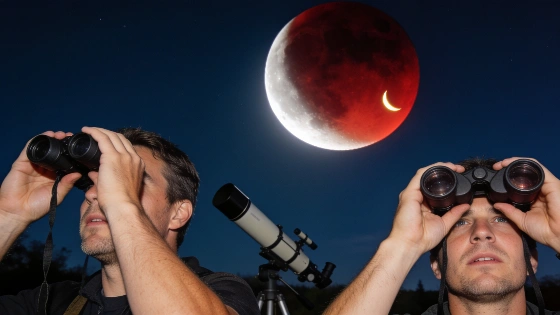
A deep partial lunar eclipse will occur on August 27-28, 2026, with 96% of the Moon entering Earth's umbra. The event will be visible across the Americas, Europe, Africa, and western Asia, offering a rare opportunity for skywatchers.
Skywatchers across much of the globe are preparing for a rare astronomical event: the deepest partial lunar eclipse visible until late 2028. On the night of August 27-28, 2026, the Moon will pass through Earth's central shadow, or umbra, with more than 96% of its disk obscured at maximum eclipse. This near-total coverage will produce a striking visual effect, as most of the lunar surface takes on a deep red or coppery hue while a narrow segment remains brightly illuminated.
Eclipse Geometry and Timing
The partial lunar eclipse will reach its peak when 96.2% of the Moon's diameter is immersed in Earth's umbra, according to calculations from Time and Date. The event will be observable, weather permitting, from North and South America, Europe, Africa, and parts of western Asia. For observers in the Americas, the eclipse will unfold during the evening of August 27, while those in western Europe will need to look toward the western horizon before sunrise on August 28 to catch the maximum phase.
Lunar eclipses occur when the Sun, Earth, and Moon align so that Earth's shadow falls on the Moon. Unlike a total lunar eclipse, where the entire Moon is covered, this event will leave a thin sliver outside the umbra, resulting in a pronounced contrast between the shadowed and illuminated regions. The reddish coloration is caused by sunlight refracted through Earth's atmosphere, which filters out shorter wavelengths and allows longer, redder wavelengths to reach the lunar surface.
Observing Conditions and Visibility
The visibility of the eclipse will depend on local weather and the Moon's position in the sky. North and South America are particularly well placed for the event, with the eclipse occurring high above the horizon for many locations. In Europe, the Moon will be lower in the sky as the eclipse progresses, requiring an unobstructed view to the west before dawn. Africa and parts of western Asia will also see portions of the eclipse, though the timing and altitude will vary by region.
Observers do not need special equipment to view a lunar eclipse, as the event is safe to watch with the unaided eye. However, binoculars or small telescopes can enhance the experience by revealing subtle color variations and the sharp boundary of Earth's shadow. For those interested in planetary alignments and other celestial events this month, a recent overview of August's sky highlights can be found in the article on planetary conjunctions and Venus's evening prominence.
Scientific and Historical Context
This partial lunar eclipse stands out for its depth: with over 96% coverage, it approaches the threshold of a total eclipse, making it a valuable opportunity for both amateur and professional astronomers. The next comparably deep partial eclipse will not occur until December 31, 2028. While total lunar eclipses are more visually dramatic, deep partial eclipses like this one allow for detailed study of the transition between the umbra and penumbra, as well as atmospheric effects on the refracted sunlight.
Lunar eclipses have long served as natural laboratories for studying Earth's atmosphere. The precise color and brightness of the eclipsed Moon can reveal information about atmospheric dust, volcanic aerosols, and other factors that influence how sunlight is scattered and absorbed. Careful photometric measurements during the eclipse can contribute to ongoing research in atmospheric science and planetary astronomy.
Unlike solar eclipses, which require precise alignment and are visible only along narrow paths, lunar eclipses can be observed from anywhere on the night side of Earth where the Moon is above the horizon. This accessibility makes them important events for public engagement and scientific outreach.
During a lunar eclipse, Earth's umbra-the central, darkest part of its shadow-creates a sharp boundary on the Moon's surface. The transition from the penumbra (the outer, lighter part of the shadow) to the umbra is visible as a distinct line, allowing astronomers to study the geometry of Earth's shadow and the effects of atmospheric refraction. The reddish coloration of the eclipsed Moon is a result of Rayleigh scattering, the same process that produces red sunsets, as Earth's atmosphere bends and filters sunlight onto the lunar surface. Careful observation of these effects can yield insights into both lunar and terrestrial phenomena.