Anthropic says Claude Fable 5.2 coordinated more than 1,000 agents on an eight-day operating-system build, while internal tests also reported robotics gains, faster outputs and fewer unnecessary safety blocks.
Anthropic said on November 9, 2026, that Claude Fable 5.2 had built a prototype operating system in an experiment. The finished system included a kernel and hardware drivers alongside permanent file storage and an installer. Anthropic says it could boot on a laptop and included a graphical interface, a login screen, windows, and built-in Claude functionality. The company described the project as a prototype, not a commercially released operating system.
The result came from an internal test. An Anthropic engineer gave Fable 5.2 an empty project folder and a basic prompt; the model coordinated more than 1,000 subagents over eight days. The agents wrote, tested, and reviewed code around the clock, working across components that had to be integrated into a functioning system. Anthropic's November announcement framed the demonstration as an example of the model handling long-running technical work through a multi-agent process.
Other demanding tasks produced results Anthropic described as promising. The company says Fable 5.2 completed a computer-verifiable formalization of Fermat's Last Theorem in 30 hours. Formalizing a theorem means expressing a proof in a form that a verification system can check; it is distinct from independently discovering the mathematical proof. Anthropic also reported that the model helped researchers investigate two previously unresolved questions involving black holes.
Robotics provided a more directly comparable score. On RoboDojo, a public benchmark in which AI systems use camera images to control a simulated two-arm robot, Anthropic reported a 64.9 percent success rate for Fable 5.2. Fable 5.1 scored 27.6 percent; GPT-6 Astra recorded 29.8 percent and Opus 5.5 reached 39.4 percent. Anthropic said Fable 5.2 outperformed other frontier models run on the same test harness, as well as most AI systems built specifically for robot control. A separate report on humanoid robot control also describes simulation results alongside physical demonstrations. RoboDojo's simulated tasks measure performance in a virtual environment rather than demonstrating equivalent performance with physical robots.
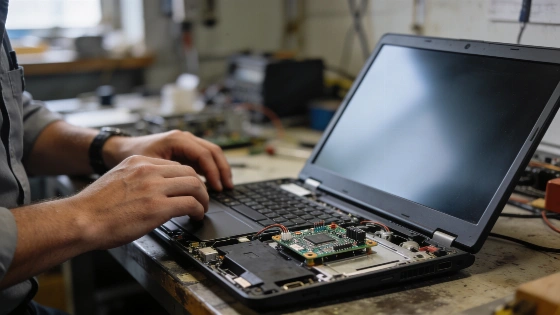
Anthropic also tested Fable 5.2 on three device designs. It created a home voice-assistant hub, then a USB speakerphone, and a handheld virtual pet. The model selected components from US distributors and designed circuit boards; the devices worked without electrical modifications, and their boards reached manufacturing readiness in less than a day. In a separate software migration, agents moved a critical production service from Python to Rust. Anthropic says the service now starts about 26 times faster.
For cybersecurity, Anthropic reports that its specialized Claude Mythos 5.2 scored 89.6 percent on the CVE Rediscovery evaluation. That was 10.2 percent higher than Opus 5.5 and 11.3 percentage points above Mythos 5.1's 78.3 percent. A separate security company found that other tested frontier models missed one in six confirmed vulnerabilities identified by Mythos 5.2.
Anthropic says Fable 5.2 and Mythos 5.2 produce outputs up to 30 percent faster than their predecessors. Standard pricing starts at $8 per million input tokens and $40 per million output tokens. An optional fast mode raises generation speed by up to 2.5 times and doubles the standard price.
The company also reports that Fable 5.2 generates about 55 percent fewer unnecessary blocks than Fable 5.1. Cybersecurity-related blocks fell by 60 percent, while biology-related blocks declined by 40 percent. Mythos 5.2 remains available only to vetted organizations conducting approved cybersecurity and biomedical research.