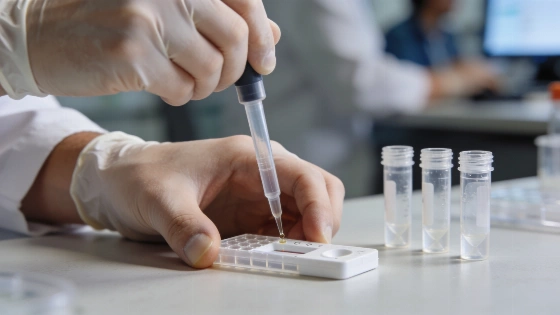
In a month-long collaboration with Divergence Labs Claude produced about 35,000 antibody designs. Early lab tests found candidates for binding IgE and detaching it from immune cells; researchers have yet to combine both functions in one molecule
At Enveda, Claude helped review 1,061 pages of pharmaceutical manufacturing records. The company says the work cut human review time by 89%, from more than 25 hours to less than three. The result concerns document review, rather than the discovery of a new medicine or evidence of clinical effectiveness.
On October 27, 2026, Anthropic described its drug-development work with six external partners: BigHat Biosciences, Bristol Myers Squibb, Divergence Labs, Enveda, Generate Biomedicines and The Column Group, alongside its own drug-discovery efforts. The reported projects included laboratory experiments and document analysis; they did not establish that an experimental treatment works in people.
For Divergence Labs, Claude converted the company's goals into a design plan and generated roughly 35,000 antibody designs over about a month, largely autonomously. The project targets immunoglobulin E (IgE), an antibody involved in allergic reactions. Some IgE circulates freely in the blood, while some is attached to immune cells.
Early laboratory tests identified candidates in two separate screens: three designs bound to IgE, and 20 could dislodge it from immune cells. Anthropic said three of the 20 dislodging designs appeared to remove more IgE than a standard medication in those tests. The results did not show that any one design both binds IgE and detaches it from cells. Divergence's next objective is to develop a molecule combining the two functions.
The distinction reflects the project's proposed mechanism. Anthropic described standard treatments as primarily neutralizing IgE circulating in the bloodstream, while Divergence is pursuing the removal of IgE attached to immune cells. The candidates remain at an early discovery stage and have not been tested in humans.
In a separate project with Generate Biomedicines, six researchers used Claude Code to redesign part of the genetic instructions in CAR T cells. One design was about 70% shorter than the standard version. In laboratory tests, modified cells produced roughly 10 times as many cancer-recognizing receptors. Anthropic also reported more efficient tumor-cell killing and longer cell activity. The development goal is to adapt CAR T therapy, used primarily against blood cancers, for solid tumors; the laboratory results do not establish safety or clinical benefit in patients.
BigHat Biosciences connected Claude to an automated laboratory system to refine two experimental antibody fragments. Researchers made and tested about 1,010 variants over 10 weeks, physically evaluating computationally proposed designs. The strongest designs bound their targets more than 10 times as strongly. One cancer-targeting candidate remained soluble at temperatures 18 degrees Celsius higher than the original, while another candidate clumped more than 100 times less readily.
Anthropic is also working with Bristol Myers Squibb on clinical-trial planning. It acquired Mithril Medicine, which is developing experimental treatments for two rare childhood forms of muscular dystrophy. One program reached promising results in mice within 18 months. Anthropic said a candidate could enter human trials as early as late 2028 if development progresses successfully.