
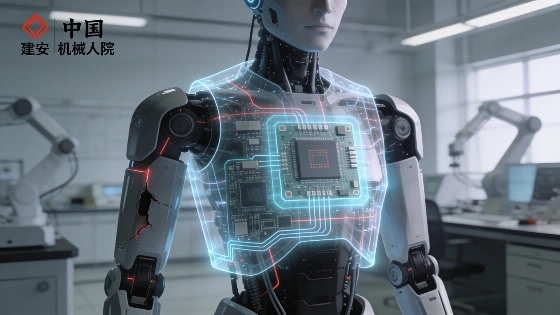
A robot unveiled in Yichang on 28 September 2026 links AI decision-making to physical control through an electronic architecture developed in China. The developers, associated with Dongtoo Tech and LimX Dynamics, report safe operation after simulated joint damage and cyberattack tests, but provide no independent verification or numerical reliability data.
A robot unveiled in Yichang, Hubei Province, on 28 September 2026 has been presented by Chinese state and industry sources as the country's first embodied AI machine built around a fully domestically developed electronic architecture. The project has been associated with Dongtoo Tech and LimX Dynamics. Its developers say the system continued operating safely after simulated joint damage, cyberattacks and implanted viruses. Those claims make the control architecture more important than the robot's appearance: it is the layer that must turn software decisions into physical movement without allowing a fault to become a loss of control.
The claim comes with a significant qualification. The developers describe the machine as the world's first of its kind, but the reported testing methods and results have not been independently verified, and no failure rates, trial counts or confidence intervals were provided. The announcement therefore establishes a domestic engineering claim and a reported demonstration rather than a measured proof of reliable operation in the field.
The control layer
Embodied AI refers to systems in which artificial intelligence is connected to a physical machine that senses and acts in the world. In this robot, reports describe an electronic architecture that brings together the operating system, networking, software tools, AI chips and control functions. That combination determines how an AI-generated decision becomes an instruction to motors, sensors and other physical systems.
Li Qingdu, executive dean of the Institute of Machine Intelligence at the University of Shanghai for Science and Technology, has described the architecture as the dependable layer between an AI system's decision and a robot's action. The developers say their design keeps AI computing and control functions separate while integrating them within one domestic foundation. That separation matters because a robot's ability to produce a decision is not the same as its ability to execute that decision safely.
In safety-critical engineering, the relevant mechanisms would normally include fault detection, watchdog timers, command interlocks, graceful degradation and isolation of compromised modules. Redundancy can improve availability, but it can also fail through a common cause, such as corrupted software, a shared power rail or a faulty sensor model. For that reason, a credible safety case requires more than a successful demonstration: it normally specifies hazards, operating limits, test protocols, failure definitions and evidence that the results generalize beyond the demonstration environment.
The architecture is also being positioned as an alternative to foreign technologies used in this part of robotics. That does not mean every component in the wider robot industry has been replaced, nor does it show that the system is superior to foreign architectures under equivalent testing. It does show how control software, computing hardware and safety functions have become part of the same strategic argument as robot bodies and actuators. The emphasis resembles the systems-engineering approach used in demanding fields at NASA and CERN, where interface failures can matter as much as the performance of individual components.
Faults under test
According to CCTV News, testing personnel subjected the robot to damaged joints, cyberattacks and implanted viruses. The report said robots using conventional electronic architectures experienced circuit failures, abrupt shutdowns or loss of control under such conditions, while the new robot reportedly continued operating safely. The developers attribute that outcome to rapid response, fault isolation and protective mechanisms within the architecture.
That is a plausible engineering objective, but the public account does not explain how the faults were introduced, how many tests were run, what counted as safe operation or whether humans intervened. It also does not establish how the robot would behave with simultaneous hardware and software failures, degraded sensors, communication loss or an unfamiliar physical environment. A controlled resilience demonstration can be useful evidence without being a safety case for deployment around people.
Physical control is where promotional claims face their hardest test. A robot working near people must remain within limits for speed, force, balance and movement even when a joint or computing component malfunctions. A previous report on a Chinese humanoid robot's earlier sprint dealt with a tightly defined performance test; this announcement concerns the less visible infrastructure that determines whether performance remains controlled when conditions deteriorate.
Researchers at MIT and other robotics laboratories commonly separate perception, planning and low-level control when evaluating embodied systems, because each layer has different timing and failure modes. A perception model may identify an object correctly while a planner selects an unsafe trajectory, or a controller may receive a valid command after the physical situation has already changed. The central scientific challenge is therefore not simply making a robot move, but measuring how reliably it maintains a safe state when its assumptions are violated.
Domestic control
The launch fits China's broader effort to reduce reliance on foreign technology across its robotics supply chain. The developers say localization means more than changing suppliers: it means controlling the underlying systems that connect AI computation with physical execution. That argument places electronic architecture alongside chips, software and industrial networking as a strategic part of robotics capability. Chinese media have framed the shift as autonomy at the level of basic architecture, with control, security and industrial sovereignty treated as linked goals.
China's Ministry of Industry and Information Technology called for a secure and reliable industrial and supply-chain system by 2027 in a guideline released in 2023. A draft outline for the 15th Five-Year Plan covering 2026 to 2030 also identifies robotics as an emerging industry for accelerated development. These policy goals provide context for the announcement, but they do not independently validate the robot's architecture or its safety performance.
Chinese regulators are also reported to be placing greater emphasis on sustainable revenue, commercial orders, lower losses and proprietary core technologies for companies seeking to develop or list humanoid and embodied-AI businesses. The criteria reportedly include control of a robotic brain or key robotic hands. This reflects a wider shift in the sector: demonstrations of walking or manipulation are no longer sufficient on their own if companies cannot show dependable software, repeatable production and real-world deployment.
The measurable record supplied so far is limited: the robot was presented on 28 September 2026 in Yichang, and the reported test conditions included three categories of disruption-joint damage, cyberattacks and implanted viruses. No numerical performance result, operating duration, intervention count or independent replication was disclosed. That absence prevents a meaningful comparison with conventional systems beyond the developers' reported description.
Peer-reviewed work in journals such as Nature has helped establish a broader scientific norm for evaluating advanced robotic systems: performance claims become stronger when researchers publish defined tasks, baselines, repeatable protocols and failure statistics. The Yichang announcement currently supplies a description of the architecture and selected stress scenarios, but not the experimental detail needed to assess error probabilities or compare safety under equivalent conditions.
For robotics, an electronic architecture is not simply a faster computer or a more capable AI model. It is a system boundary that determines which commands reach the machine, how faults are detected and whether compromised or damaged components can be isolated. The Yichang unveiling is therefore significant as an effort to establish domestic control over that boundary, but the evidence currently supports a reported prototype demonstration rather than a verified safety breakthrough.
Future evaluation would need to report the number and duration of trials, the distribution of fault types, sensor and network conditions, intervention rules, near-miss events and predefined criteria for safe operation. Independent laboratories should also be able to reproduce the tests and compare the system with conventional architectures. Until those data are available, the robot is best understood as an important industrial and architectural milestone whose resilience claims remain provisional.