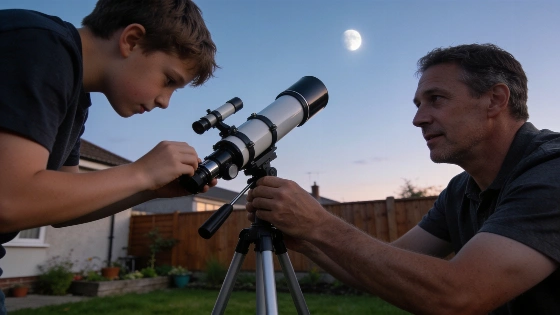
A review of the Celestron Moon Mission Travel Scope 70 examines its optical performance, ease of use, and limitations for beginners and young astronomers, highlighting what this portable refractor can and cannot reveal in the night sky
Accessible, lightweight telescopes have become increasingly capable, offering new opportunities for beginners to observe the night sky. The Celestron Moon Mission Travel Scope 70 is a compact refractor designed to introduce users to lunar and planetary observation, with a focus on simplicity and portability. Its design and included accessories aim to lower the barrier to entry for those new to astronomy, especially younger observers.
Instrument Design and Features
The Moon Mission Travel Scope 70 is a refracting telescope with a 70 mm (2.8-inch) aperture and a focal length of 400 mm, yielding a focal ratio of f/5.7. The kit includes two eyepieces (20 mm and 10 mm, providing 20x and 40x magnification), a 3x Barlow lens, a moon filter, a star diagonal, a 5x24 finderscope, and a moon map. The telescope and accessories are housed in a travel bag, and the entire setup weighs approximately 1.5 kg (3.3 lbs). Assembly requires no tools, and the manual alt-azimuth mount with a pan handle allows for straightforward pointing and tracking.
The tripod extends from 56 to 132 cm (22 to 52 inches), accommodating both seated and standing use. All components are lightweight, reducing the risk of injury if dropped, though the optical tube should still be handled with care. The inclusion of software downloads, such as Starry Night and Celestron's Sky Portal app, provides additional educational value for users learning to navigate the sky.
Performance and Observational Limits
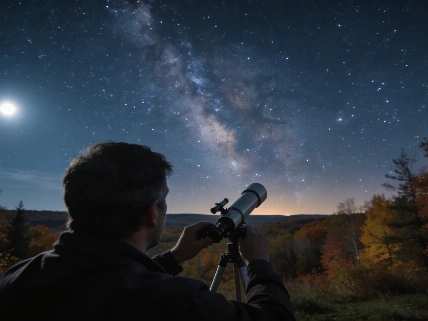
During field tests, the telescope provided clear, wide-field views of the Moon, easily fitting the entire lunar disk in the 20 mm eyepiece. Surface features such as the crater trio Theophilus, Cyrillus, and Catharina, as well as prominent lunar maria, were visible. At 40x magnification, the Moon filled the field of view, revealing shadowed crater walls and illuminated highlands near the terminator. The instrument also allowed tracking of Jupiter's four Galilean moons, though atmospheric details on Jupiter itself were not resolved due to the limited aperture.
Open star clusters like Messier 35 were detectable, appearing as faint groupings of stars. However, fainter objects such as NGC 2158 remained beyond reach, illustrating the constraints imposed by a 70 mm aperture. The 3x Barlow lens, when paired with the 10 mm eyepiece, produced 120x magnification, but the resulting image suffered from significant blurring and loss of detail, indicating that high magnification is not practical with this instrument's light-gathering capacity.
Functionality and User Experience
The telescope's optical quality is consistent with expectations for its price range, with clear images at low to moderate magnifications. The supplied eyepieces are serviceable, and the focuser operates smoothly. However, the included tripod is notably unstable, introducing vibrations that can blur the view and require time to settle after adjustments. This is a common limitation among entry-level telescopes, and users seeking a steadier experience may wish to upgrade the tripod.
Accessory quality is mixed. The moon filter tended to dull and redden the lunar image, which may be preferable for some users when observing a full Moon but is not essential for crescent phases. The 3x Barlow lens is of limited utility, as the telescope's aperture does not support high-magnification viewing. For those interested in deep-sky observation or astrophotography, the instrument's capabilities are modest, and more advanced telescopes would be required.
Suitability and Alternatives
The Celestron Moon Mission Travel Scope 70 is best suited for beginners and children interested in lunar observation and bright planetary targets. Its affordability and ease of setup make it a practical choice for those starting out. However, users seeking to observe faint deep-sky objects or to pursue astrophotography will encounter significant limitations. For those interested in more advanced capabilities, alternatives such as the Sky-Watcher Explorer 130 EQ2 or Celestron's StarSense Explorer LT70AZ offer larger apertures or enhanced technology at higher price points.
Customer feedback for the standard Celestron Travel Scope 70, which shares its optical design with the Moon Mission edition, generally highlights ease of use and portability, while echoing concerns about tripod stability. For context on how amateur astronomers have used larger telescopes to capture faint objects, see this report on a recent comet observation in Namibia using a 12-inch instrument.
Understanding the limitations of small-aperture telescopes is essential for setting realistic expectations. While the Moon Mission Travel Scope 70 cannot match the performance of larger, more expensive instruments, it provides a functional and accessible entry point for those beginning their exploration of the night sky.
In astronomy, a telescope's aperture-the diameter of its main lens or mirror-determines how much light it can collect. Larger apertures gather more light, allowing observers to see fainter objects and resolve finer details. However, increased aperture also means greater weight, cost, and complexity. Entry-level refractors like the Celestron Moon Mission Travel Scope 70 trade light-gathering power for portability and simplicity, making them suitable for bright targets such as the Moon and major planets, but less effective for faint deep-sky objects. Understanding this trade-off helps new astronomers choose equipment that matches their observing goals and practical needs.