Astronomers assess whether Perseid meteors will be visible during the total solar eclipse on August 12-13, 2026, as the Moon's shadow crosses Greenland, Iceland, and Spain, and explain the observational limits imposed by eclipse conditions
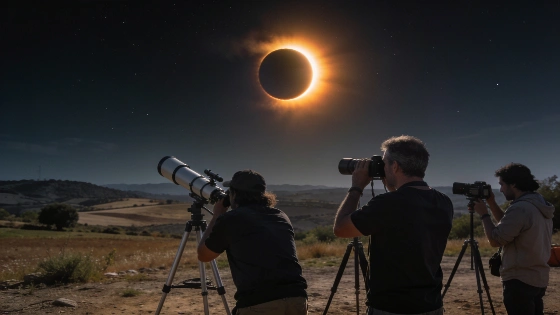
The total solar eclipse scheduled for August 12, 2026, will coincide with the peak of the Perseid meteor shower, raising the question of whether observers in the path of totality might glimpse meteors during the brief period of midday darkness. The event will draw millions to regions of Greenland, Iceland, and Spain, where the Moon will fully obscure the Sun and create a rare window of artificial twilight. However, the likelihood of witnessing a Perseid meteor during totality is shaped by both the brightness of the sky and the fleeting duration of the eclipse's darkest phase.
Perseid Meteor Shower and Eclipse Timing
The Perseid meteor shower occurs each August as Earth passes through debris left by comet Swift-Tuttle. At its peak, the shower can produce up to 100 visible meteors per hour under optimal dark-sky conditions. In 2026, the shower's maximum activity will overlap with the total solar eclipse, but the period of totality at any given location will last only about two to three minutes. This brief interval, while significantly dimmer than normal daylight, does not replicate the deep darkness of night required for most meteors to be easily seen.
Perseid meteors are typically observed after midnight, when the radiant-the point in the sky from which the meteors appear to originate-rises higher above the horizon. During the eclipse, the Sun will be blocked only temporarily, and the sky will take on the appearance of deep dusk rather than true night. As a result, only the brightest meteors, known as fireballs, have any realistic chance of being detected by the naked eye during totality.
Observational Limits and Meteor Visibility
Both the intensity of the eclipse and the brightness of the Perseid meteors determine the odds of a successful sighting. According to meteor researchers, the Perseids produce roughly one fireball-an exceptionally bright meteor-every three hours during peak nighttime activity. Given that totality at any location lasts just a few minutes, the statistical probability of a fireball appearing in the right part of the sky during the eclipse is extremely low.
Even under the best circumstances, the sky during totality remains brighter than a typical rural night sky. This means that faint and moderate-brightness meteors will be washed out by the residual light. Only the most luminous Perseid fireballs, which can briefly outshine Venus, might be visible if they occur in the darkest portion of the sky away from the eclipsed Sun. Most observers should not expect to see any meteors during the eclipse, though the possibility cannot be entirely ruled out.
Comparisons With Other Celestial Phenomena
The challenge of observing meteors during a solar eclipse is similar to the difficulty of seeing auroras or other faint night-sky phenomena in daylight conditions. As discussed in Science Report's coverage of auroral visibility during eclipses, the limits imposed by the Sun's residual brightness and the brevity of totality make simultaneous observation of multiple faint phenomena unlikely. For the Perseids, the combination of timing, sky brightness, and meteor frequency means that only a rare coincidence would allow a meteor to be seen during the eclipse itself.
For those hoping to photograph both the eclipse and meteors, experts recommend focusing on the eclipse during totality and reserving meteor observations for the hours before dawn, when the sky is truly dark and the Perseid radiant is high. Specialized guides for eclipse and meteor photography can help maximize the chances of capturing each event under optimal conditions.
What to Expect for Observers
While the prospect of seeing a Perseid meteor streak across the sky during a total solar eclipse is enticing, the evidence suggests that such an occurrence would be exceedingly rare. The overwhelming majority of observers will experience only the dramatic transformation of daylight into twilight as the Moon covers the Sun. The Perseid shower will remain best viewed under dark skies away from city lights, particularly in the early morning hours when meteor rates are highest.
For those in the path of totality, the eclipse itself will offer a unique opportunity to observe the Sun's corona and the changing sky. Any meteor sighting during this period would be an extraordinary coincidence rather than an expected feature of the event. Observers are encouraged to enjoy the eclipse as it unfolds, with the knowledge that the Perseids will continue to provide a reliable spectacle throughout the night.
Understanding the interplay between meteor showers and solar eclipses requires familiarity with how light conditions affect human vision and astronomical detection. During a total solar eclipse, the Moon blocks the Sun's direct light, plunging the landscape into a temporary twilight. However, the sky remains much brighter than during true night, limiting the visibility of faint objects such as meteors. Only the most brilliant meteors-fireballs-can overcome this background brightness. The rarity of such events during the brief window of totality means that most observers will not see meteors, but the underlying physics highlights the importance of sky darkness in astronomical observation.