A warehouse trial reportedly added more than 15,000 packages of annual sorting capacity per robot. The method uses simulated tests to refine controls before they run on physical machines
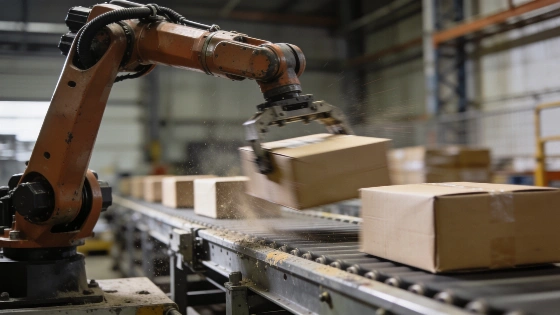
A warehouse robotics company reported a gain of more than 15,000 packages in annual sorting capacity per robot after testing AI-generated control updates. The improvements have been deployed across 30 percent of its U.S. fleet.
The approach tackles a persistent robotics bottleneck: engineers often program robot behavior by hand, while learning from demonstrations can require large datasets. UC Berkeley researchers presented Graph-as-Policy (GaP), an agentic robotics framework, at the 2026 Conference on Robot Learning. AI agents generate and revise control programs, testing them in simulation before they are considered for physical deployment. Ken Goldberg, a UC Berkeley engineering professor and roboticist, described the workflow as teams of agents developing robot-control programs, testing them in simulated environments and revising code when something fails, as reported in UC Berkeley's announcement.
GaP represents a robot program as connected, reusable skills, including finding objects, planning grasps and moving a gripper without collisions. Agents assemble those perception, planning and control components into a larger program rather than requiring engineers to hand-code each behavior. The programs are designed to remain interpretable so engineers can inspect and review them. NVIDIA Isaac simulation technologies let agents rehearse programs across variations and revise them when tests reveal problems.
Berkeley and NVIDIA also released VABAR, the Variational Automation Benchmark for Agentic Robotics. The benchmark evaluates robots across six industrial task categories, including tool sorting and handing, syringe packing, and cable insertion and routing. It is connected to NVIDIA's Isaac Lab-Arena framework and is designed to test performance in varying conditions, including contact-rich interactions between robots and objects, as NVIDIA's CoRL coverage describes.
In one demonstration, researchers gave an AI system a short video of a robot wiping ink from a metal bar with a sponge. Within an hour, it produced a physics simulation that reproduced the task, including sponge deformation, then generated and refined a robot-control program. The physical test exposed a flaw: the robot pushed the bar over because its weight had been estimated inaccurately. Video of that attempt was used to update the simulation and revise the controls.
The cycle makes failed physical attempts useful for improving later simulations. Simulation remains a rehearsal and revision stage rather than a replacement for physical testing, since differences in object properties and contact behavior can affect how a program transfers to a real robot. The parcel-sorting result is reported by the company. A separate Atlas control experiment also examined simulation-trained robot behavior, though it involved a different task.
The researchers are releasing open-source code built around NVIDIA Isaac, alongside the industrial benchmark. The method's demonstrated applications remain focused on structured industrial tasks; it does not show that robots can independently master arbitrary real-world activities.