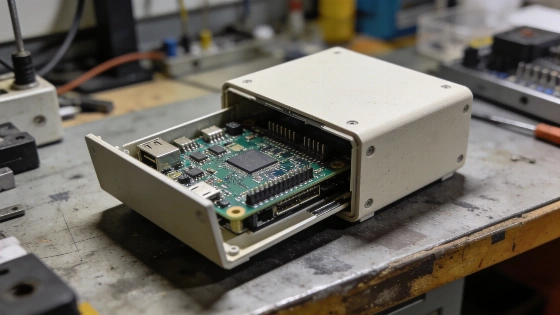
Two OpenAI team members used GPT-6 and Astra to create a Codex-connected device in under a week. The prototype covered hardware and software, but production preparation still required engineering review and adjustments
A contract manufacturer produced a small batch of the devices in less than a month. Preparing the design for manufacturing exposed limitations that the fast initial build had not resolved. OpenAI described the project in an engineering account published November 3, 2026, saying the prototype was designed in under a week.
Two OpenAI team members developed the prototype as a side project. GPT-6 helped set its functional requirements, while Astra worked on the enclosure, internal structures and electrical-component selection. The project also covered a custom printed circuit board (PCB), firmware, a user interface and software integrations for connecting the device to Codex.
The experiment tested whether models could carry out a hardware development process without direct human edits. Manufacturing brought a different set of demands. Astra struggled with production restrictions and component tolerances, and engineers needed several review and revision rounds to address manufacturing and assembly requirements before the small batch could be produced.
OpenAI says engineers still need to assess and adjust designs before manufacturing. The prototype showed how quickly models could generate an initial design; it did not establish that the resulting hardware was ready for production without oversight. OpenAI's teams also use Codex and ChatGPT to create and revise CAD models, prepare manufacturing drawings, set up simulations and review designs.
OpenAI reported a 23-fold increase in model usage across its hardware teams between February and October 2026, measured through token consumption. The company said its hardware and infrastructure groups apply the tools to CAD work, manufacturing drawings, simulation setup and design reviews. Grace Lam, a forward-deployed engineer at OpenAI, said Codex has accelerated the path from concepts to engineered components, including CAD revisions and converting 3D designs into production-ready 2D drawings.
OpenAI also reported results from its internal BenchCAD 2.0 evaluation, which tests whether models can reconstruct 3D parts and assemblies and identify connections on circuit boards. A newer internal model scored an average of 0.875, while GPT-6 Astra scored 0.594 at its highest reasoning setting. The difference was 0.281 points, or about 47% relative to Astra's score. OpenAI described the results as early evidence of improving engineering capability.
Industry trials remain another part of the work. OpenAI said its hardware and infrastructure teams are applying Codex and ChatGPT to robotics and compute-infrastructure projects. At Chip Ganassi Racing, R&D engineers are exploring ways to turn 3D scans into editable CAD models and generate manufacturing drawings. OpenAI has also described work with Mazda to explore vehicle designs through simulation. Mazda engineers evaluate promising configurations against styling requirements and development costs.
In its engineering account, OpenAI said its teams are continuing to use models in hardware workflows, with engineers reviewing outputs and identifying where they need improvement.